Showing posts with label Car Talk. Show all posts

Wednesday, September 24, 2014

Keep My Brother - The Art of The Possible

"If politics is the art of the possible, then compromise is the artistry of democracy"
-Amy Gutman and Dennis Thompson, The Spirit of Compromise: Why Governing Demands It and Campaigning Undermines It


As the guys on Car Talk like to say in describing their puzzlers, this post is quasi-political, quasi-Buddhist, quasi-film and no small part personal confession and realization.

You've been warned.

If you're a regular reader, none of the above surprises you - including the schizophrenic mix.

You don't need me to link you to political sites to know that our current state of politics is not working, and while the reasons are varied and the answer much too complex for me to get into here, it is failing because compromise has become a dirty word. (quasi-political - check!)

On Keep My Brother, I developed a new-found respect for the true art of compromise at it's best. Going in, I had a game plan for pulling off what I correctly thought would be a difficult feat - shooting a 98 or so page script with F/X in 12 days, more than a few of which would be more than 10 pages, given location, actors, etc.

The game plan included using a small lighting package provided by the gaffer, augmenting the natural light from the interior of the nightclub (which had a full skylight as a roof), a lot of handheld, and a "small footprint."

"Small footprint" was how I approached the previous feature I line produced, and, on that film, it did not work out. The DP - incredibly talented, but not fast and not particularly interested in the budget - was on first, and basically set the tone with too much camera gear, and hired a gaffer who, frankly, was a grip pretending to be a gaffer. That gaffer over-compensated by basically bringing every light she could, and had no idea how to light any other way.

The problem with all of that, beyond the rental costs (same lighting vendor as this shoot, and a good deal from the camera vendor as well) are the ancillary costs: trucks to carry them, people to drive those trucks, parking, gas, etc. You also need more people in the department - what should have been a Grip/Electric department of two grips and two electrics became 3/3, respectfully.

All of that is added cost that does not wind up on screen, and, I assure you, it did not. When you have producers fighting you and backing the DP, not a lot you can do.

In his book  Understanding Our Mind: 50 Verses on Buddhist Psychology
 the noted Buddhist teacher Thich Nhat Hanh talks about the "seeds" in our mind that make up "store consciousness." It gets deep, but here is one basic understanding: (quasi-Buddhist? check)

"If you are not mindful, you will believe that your perceptions, which are based on prejudices that have developed from the seeds of past experiences in your store consciousness, are correct."

I definitely brought that and previous experiences with DPs who were difficult to this project, sometimes not seeing when Lauretta, our DP, was trying to work with what we had.

Make no mistake: my perception was not totally off. Lauretta's idea of "small footprint" and "simple lighting" was different than mine, as was, to an extent, our gaffer, Adam's, who thought that the additional lighting gear would truly save time and that every bit of it was essential.

I also believe that my hard line early on costs and sticking to my guns on size and number of vehicles made a huge difference in the budget.

That said, on the day of our final production meeting in prep, Lauretta and I definitely had different agendas for the day; both with what we thought was the best interest of the film in mind. We butt heads during the meeting, and afterward had a two-hour or so talk that, in retrospect, I wish I could have on almost every project. I say in retrospect, because at the time, it was painful for both of us.

It was the two of us as DP and Line producer, but also as friends and respected colleagues, being increasingly honest with each other. Anyone who has had a conversation such as this one - say, a "status of our relationship" discussion with a significant other, knows that while good can come of it, it can also leave scars and go in the wrong direction.

We both spoke our mind. In fact, this may have been the most important two hours of the project. Although neither of us walked away convinced the other was correct, we did agree that it was impossible that either one of us were completely correct. Seems obvious, but if you've every had one of these discussions, you know that while it may be obvious, it is not an inevitable conclusion.

It set the stage for all the encounters we had regarding lighting and time and coverage for the rest of the shoot. Yes, there was disagreement, but underlying was a deep mutual respect as well as truly liking the other person. I can honestly say that our relationship as colleagues and as friends is stronger now than when we started the project.

The compromises from her side definitely helped us get through everything on time; the compromises on my side allowed her to do a really incredible job and make a better-looking movie than the budget or circumstances would suggest, and, frankly, better cinematography than either I or the director envisioned.

We were not the only ones making compromises.

Our director had an idea for a night scene that when the robbers arrive that was crucial to his vision of the film. Unfortunately, we had a difficult police officer as part of our film unit who decided when he got there that he was going to lay down the law and show us who was in charge.

The NYC police film unit is usually great. On shoot after shoot, they have worked with us on things that might not be on the permit but made sense as long as we were working reasonably with them from a safety aspect. Also, most police are thrilled to be in this unit - there is no easier gig.

This guy was the exception, and, in holding to the letter of what was on the permit, it meant a compromised way of shooting it. Mike, our director, made it work, though we later added a bit somewhere else to get closer to his vision. Without getting into particulars, NONE of this involved weapons, stunts or safety.

We also had a day where the production designer's assistant, the art director, failed to do his job the night before a major set needed to be ready. When we got there, it was clearly hours away from getting done. The PD, along with production help and help from the director's friends, got it done by afternoon, while we shot a different scene with the same cast, as well as the director agreeing to move one scene from that office set to the nightclub floor. Compromise, and in a way that I doubt any viewer who hadn't read the script would notice or mind the change of set. That's the key.

I tried going without a caterer at first, hoping we could patch together restaurant deliveries and have production provide craft service. For most of the shoot, though, we found a guy who wanted to be a filmmaker but was able to cater and do crafty within my small budget and keep everyone happy. That worked for most of the shoot until near the end, when he completely melted down and flaked out. Tasha and I pieced it together with a local diner that worked with us and me buying crafty and breakfast and using the money wisely but still providing hot, good meals and more than sufficient crafty.

Because my production coordinator/manager Tasha was so good, we were able to juggle all of the tasks of production with two interns as unit manager and APOC, and one incredibly loyal and hard-working PA, Jack, who stood tall when all the other PAs fell by the wayside.

Other compromises included not having a paid 2nd AC - a great intern did the first week, and our paid DIT jumped in and did double-duty the second week.

As with any shoot, everything did not go smoothly. We hit all of the bumps mentioned above, and probably a few which I have either forgotten or blocked out already - the mind has a great way of protecting us, doesn't it?

In the end, we all kept in our hearts what we wanted and thought was best, but with our eyes firmly focused not on the perfect, but on the possible.

We did not fall victim to a trap first proposed by the French philosopher Voltaire (did I say quasi-philosophical?), often quoted by politicians:

"The perfect is the enemy of the good."

We were far from perfect - but we were very, very good.


Saturday, August 11, 2012

JB-San to the Rescue - Part 3 - The "Car Talk" Call


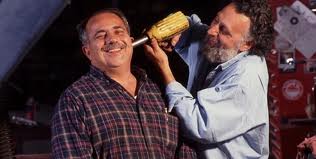
It was announced earlier this year that Car Talk, an NPR show that has been delighting audiences for almost 35 years, will cease to produce new shows later this year.  With 35 years of shows, their producer will put together composite shows, that will run, as co-host Tom Magliozzi suggests, "...like 'I Love Lucy' and air ten times a day on 'NPR at Nite' in 2075."

I first ran across Tom and Ray ("Click and Clack - The Tappet Brothers" as they like to describe themselves) on a Saturday morning while turning to one of my usual NPR stations.  I caught the show somewhere in the middle, and all I knew that two guys with deep Boston accents were giving people car advice such as this (Sample - not from actual show):

CALLER: My car makes this really loud noise when I go over 40 miles an hour.

TOM: Ooh.  Ooh.  Make the noise.

This would be followed by the caller making some silly sound and asking if they could help him (or her).

RAY: Sure.  Turn your radio up real loud.

CALLER: Will this fix the problem?

RAY: No - but you won't hear the noise any more!


I'm doing the guys a disservice - they are much funnier -and upon more listens, I realized these two "dummies" were actually engineers, one of them holding a PhD in Engineering from MIT.  None the less, they so much became a part of pop culture that they played animated versions of themselves in the Disney film Cars, with their signature sign-off advice.

TOMMY: Don't drive like my brother.

RAY: And, don't drive like my brother!

They also became a regular part of my Saturday mornings.  Certainly, with webcasts and such, I could listen at any point during the week, and would if I missed them on Saturday at 10AM.  However, that hour and day seemed perfect - not too early to start off the weekend, not too late to get out and do things on a nice Saturday.  My weekend was guaranteed to start off with a belly laugh or two, and not many things make me belly laugh, but in no week did I not find myself truly laughing out loud (no, not LOL - the real thing).

Their self-deprecating humor (they have a "Hate Mail" section on their website) was in full swing a few weeks back when a listener wrote in saying he wanted to start a boycott of the show, but had no way to reach their audience, and could they help.  Sure enough, they read his letter!

I got to thinking about Tommy and Ray, and their last original shows, as I thought of what element of the insanity that was Haebing to cover next.  Without a doubt, motor vehicles were a large part of the insanity, much of which I chronicled in Part 2 of this series.

The first incident could have been a call on "Car Talk," from one of our favorites on the Korean crew, Yu Bong.  It would go something like this:

RAY: Hello, this is "Car Talk."  Tell us your name and where you're calling from.

CALLER: My name is Yu Bong.

TOMMY: Yu Bong.  Let me guess.  Is that Y-O-U B-O-N-G

YU BONG:  No "u".

TOMMY: (laughing) : No, "you".  You're the one calling.

YU BONG (laughing - he had a very cheery disposition and would instinctively laugh with you, even if he didn't get the joke):  Yes, me!

RAY: Where are you calling from, Yu Bong?

YU BONG:  New York City.

TOMMY: From your accent, Yu Bong, I take it you're not originally from New York.

YU BONG:  No,  I'm from Busan.

RAY: What brings you to New York Yu Bong?

YU BONG:  I'm working on a television show, and I'm working with some fun people from New York.  They told me something and I wanted to find out if it's true.

TOMMY:  Ah, so you have some doubts about something one of your American co-workers told you.

YU BONG:  I hope it's true, because it is pretty good - for me, I mean.  I was about to leave work the other day, and Peter, our production manager, asked if I could take the 7-passenger van with me.  At first, I didn't really want to drive any more, but then he said it could be my van to use after work.

RAY: So, he offered for you to use it for your personal pleasure, is that it?

YU BONG: Yes, like that.

RAY: And, what, exactly, if I may ask, is your personal pleasure, Yu Bong. (Tommy and Ray can be heard laughing at this point).

YU BONG: JB - he is the American boss - he tells me that 7-passenger vans are "Chick magnets."

Laughing increases.

RAY: "Chick magnets?"

YU BONG : Yes, that's what he said.  He seems to have been around, so I expect he knows.

TOMMY: Oh, really.  What did Peter say?

YU BONG:  Peter must have known as well, but he forgot to tell me, because once JB mentioned it, Peter starting saying, "Yeah yeah.  It's a chick magnet!"

RAY: (laughing) : Right, he forgot to tell you.

YU BONG:  So, tell me, is this true.  Is 7-passenger van a chick magnet?

RAY: It's hard to say what type of car is a "chick magnet", Yu Bong.  My brother Tommy has, however, discovered every car that is a "chick repellent."

TOMMY:  Yu Bong, let me ask you.  Does your leg hurt?

YU BONG: No.  My leg feels good.  Why?

TOMMY: Because I think that knucklehead JB is pulling your leg.


I have no idea whether Tommy and Ray would have told him the truth like that, or kept him going, but we always had one vehicle too many, and it seemed a harmless, white lie, in the grand scheme of things, might help to solve things with a minimum of muss and fuss.  Yu Bong started taking the 7-pass - whether it ever fulfilled his wished, I don't know.

The other incident would be too weird even for Click and Clack.

At one point, I apologized to the manager of the van and truck rental service we were using.  A good deal of their work was with the film business in New York, and they had seen everything, but the constant switching out of vehicles, the constant nicks and dents (the Koreans were not good at our road rules) exceeded even the poor returns to which they had become accustomed.

Peter had one of those dispositions where he might be fuming or worried inside, but would force himself to act calm.  There was a lot of George Kostanza in Peter, though he was a good deal younger.

One day, I heard his voice get increasingly louder as he searched through papers on his desk frantically while talking to one of our drivers on the phone.

PETER: "Where are you?"  (Pause). "Ireland?" (Pause) "What island?"

I start mouthing some possibilities.  City Island?  Coney Island?  Long Island?  Please don't let it be Governor's Island, as there is no reason in the world why he should be there.  Then again, we weren't scouting any of the others, either.

We finally established that it was Long Island, but where exactly where was still undetermined (we started running through towns, then exits on the Long Island Expressway).

As I noted earlier, the Koreans insisted on having their drivers go out, even though many of them spoke little English, so road signs often meant as little to them as Korean road signs would mean to me.

PETER (into phone):  OK, get in the car....you're in a truck?  What truck?

Again, Peter tried to determine which truck he might be in.  He mentioned traffic, so maybe the Long Island Expressway; bad, but not as bad as if he was on one of the Parkways, which are off-limits to trucks or commercial vehicles (most of our rentals, even the small vans, had commercial plates).

I asked Peter if he was okay, but, as I would have imagined, Peter had already determined that he was - that's the first thing we ask.  Vehicles can be fixed and replaced.

PETER (into phone): Now, I don't want you getting back in the car....I'm sorry truck...until we know where you are.  Parkway?  What Parkway?

Oh, this wasn't good.  His license permitted him to be driving, but not on the Parkway with a commercial vehicle.  I started preparing my mea culpa to the nice Nassau County Highway Patrolman who was sure to be the next call.

PETER: (into phone)  Ok, I don't want you to get back on the Parkway in the truck...wait, I thought you said it was a truck?  Convertible?  What convertible?

Now, I was really confused.  We had rented a lot of vehicles, but, as far as I could tell, even the picture vehicles weren't convertibles.  What were we doing with a convertible?

PETER (into phone):  Give me the plate number.  The plate number. (Pause)  We don't have a convertible!

Peter listened closely, and it seemed that he had a revelation.  His expression first took a turn for the worst, but when we met eyes, a strange thing happened.  He started laughing uncontrollably.

If there was something funny here, I was missing it.  However, Peter's attempt to clarify with the driver made it all clear to me.  Peter was now letting me in on what was happening.

PETER: (into phone):  So, there is no roof on the cab of the truck....No, not cab, truck.  The front part of the....How did the roof come off? (Pause).  Did you realize you weren't going to be able to go under...Okay, Okay.  Just stay where you are.  We're sending someone to pick you up.  (Pause) Yes, the convertible, too.

The Southern Parkway on Long Island has many wonderful features.  It also has some low overheads, which  is not usually a problem, as trucks are not meant to be on the Parkway.  Our driver could not imagine why there would be overheads too low for a truck, and by the time he had discovered that there was, it had sheared the roof off.  Amazingly, my driver was able to pull the truck to the side of the road, and neither he nor anyone else was hurt.

As I later learned from the manager of the rental house, the tow truck driver told him that we all got lucky because the roof 'peeled back like a sardine can .'  It had not fallen onto the roadway.  All of that was too difficult for our driver to convey in the little English he had at his disposal; "convertible" was the only word he could think of, and if driving with an unencumbered view of the open sky above was one of those definitions way down in the dictionary of a convertible, our driver was, technically, correct.

From that point on, when Peter or I told the manager at the rental place that we had to bring in a vehicle, he would ask things like, "can you drive this one in, or do we have to pick it up," and " does this one have a roof?"

Yeah, the joke was very much on us.

And don't drive like my Korean drivers.