Tuesday, December 11, 2012

Party Like It's 1999 - Part 1 ...When the Big Man Joined the Band


"When The Change was Made Uptown
And the Big Man Joined The Band"
Bruce Springsteen
Tenth Avenue Freezeout

So, this post, this turning point in my career, starts with an Assistant Director getting replaced; and a good one. As I have pointed out, this is a more common occurrence than you might think.  As a matter of fact, it became something of a recurrent theme, as my first gig as First AD came replacing someone.

In this instance, it was someone I knew, and a very good Assistant Director. I never found out the reason for the change, but got a feeling it was mutual and not acrimonious. The brief introduction to the project by the producers did not include any scathing indictment of the previous AD, and my brief conversation with the previous AD did not come with recriminations of the producers. This was, at least, a good sign.

The movie, 1999, was about a party on the eve of the millennium, which was then a little bit away. It was being directed by Nick Davis. In speaking of my old friend, the talented writer/director Raymond DeFelitta, I pointed out how it was years after I first met him that I realized that his father had been in the business. Similarly, 1999 was long-wrapped before I discovered that he came from an industry family, and I mean, a
"breeding on both sides," as they say in horse racing, that would have impressed anyone. His father is film director Peter Davis, his paternal grandparents were both acclaimed screenwriters, and his maternal grandfather was the legendary Herman J. Mankiewicz.

I've worked with people who had a fourth cousin that was an assistant editor on a Scorcese film that reminded you of this hourly, and the fact that it never came up once in all my time with Nick says a lot about his character. The only equivalent I can think of is someone failing to tell you they were a Kennedy.

I did know there was something special going on. Here was a director without any lengthy resume shooting a film with some actors I knew, comic Steven Wright and The Graduate author and Saturday Night Live regular Buck Henry. I was also told that some of the young actors on the shoot were "up-and-coming," what I used to refer to as "industry hot." (much more on that in subsequent posts).  I certainly was not familiar with them. While IMDB had been around for a few years at that point, it was certainly not the industry standard it is today, so checking people's credits still had some mystery.

To the logistics of the movie:

All of the action took place in one townhouse. We were shooting the main action on 35mm, but director Davis, himself a documentary filmmaker, would also be a "character" who shot home movies on video, and that footage would also be used.

The townhouse was three floors, with most of the action on the first and second floors. Production and holding for actors was mostly on the third floor, so it would not have to be struck constantly. Because the party happens over one night, continuity was a big issue. We had to bring back most of the extras for background - it would make little sense to see different people in the background in every shot at a party that happens over one night. As I will also go into with subsequent posts, there were actor conflicts.

All of this meant I was walking into a lot of logistics to deal that had to be addressed without a real feel for how it was being handled.

On my first day, the producers walked me through, and introduced me to the two 2nd ADs, who had not been let go. One of my first decisions would be whether to keep the 2nds or replace them.

This was a hard one. I figured they knew a lot more about what was going on than I did, and that could be helpful. When these sorts of parting happen, however, producers sometimes like a clean break. All of the reasons to replace them would have been political. Would they resent me? Would it make the producers happy? Should I bring in someone loyal to me?

If you think politics has no place on a film set, well, good luck with that.

I did not have someone waiting in the wings. I had been PM and line producer more than an AD recently, so I didn't have a regular second, and my calls to the few seconds who I trusted turned up people who had either moved up to First AD or were not available.

Talk about good fortune.

I decided to give the two, Amy and Brian, a chance. If nothing else, they could guide me until I found replacements.

We didn't exactly shoot in sequence, but we tried to stick to it somewhat, so there was a lot of striking set, moving to the next one, coming back to the first. Not my preference from either a logistical or scheduling perspective, but, hey, we weren't there to make things easy for the 1st AD. I already had the luxury of one building to deal with; I was not about to complain.

So it was, a moment I will always remember. The PAs were responsible for striking sets and clearing rooms for the next set, while art department dealt with the details. We had a lot of PAs, almost all of them without much experience. It amounted to a lot of "hands," which was exactly what I needed as we wrapped one set and were moving on to the others.

Neither Brian nor Amy were shouters, which was good. Over the years, I had developed a calmer demeanor, and always hated screaming on set. It just sets such a bad mood, but, we were still in the age when, as one co-worker once famously said to me, an AD was often thought of as "a grip with an attitude." Sure, on DGA gigs, this would be ridiculous, but on the low-budget indies, we were doing our best to establish demeanor and rules in the absence of anything on paper.

I got on walkie and calmly said, "Hands, please." There was some shuffling and scuttling, but not in the way of movement into the room, certainly not as fast as I would have liked. I also only heard my two ADs reply with, "copy."

Now, this is a major annoyance with newbies on walkies, PAs who don't "copy." It means I don't know if you heard me and are just not doing it, you lost your walkie, you're "on a mission" (someone else in charge has you doing something) or just fell asleep in the corner.

I get back on walkie: "I need hands, please. PAs, please copy." Static.

As a deep sigh was leaving my lungs, I feel the movement erupts like a volcano. Over walkie comes this voice, calm but firm, only slightly raised.

"I heard JB call for hands. Is there a reason no one is copying?"

Next came an immediate string of "copy that"s, followed by PAs running into the room. Before the ones who were just outside the room made it in, there was Brian, my 2nd, having made it down two flights of stairs moving things and directing PAs.

In bad Rom/Coms, this is when they backlight people and play violins. Don't get me wrong, Brian and I are happily straight, but I took one look at this calm big man, making things happen, and I thought, "you're not going anywhere."

When working as a 1st, chemistry with your 2nd is important. It is even more important when you line produce and UPM and need to work with a 1st AD. The problem with 1st ADs who move up to UPM or line producer is we tend to either expect our 1st ADs to work like us, which is unrealistic, since no two people are alike, or we tend to micromanage. The solution is finding someone whose style may not be exactly like you, in fact, who can complement you with their difference, while respecting them.

This was that guy. A big man with broad shoulders (I later learned his friends called him "Biggs") he was nonetheless always calm and quiet, but when he needed to make a point, everyone listened. He commanded respect because of how he dealt with problems on set and, more importantly, how he dealt with people. We've worked together many times over the years, and never, not once, has anyone come up to me and asked, "why did you hire him?"

Truth be told, I think those same people liked him more than they did me. That's just fine by me - I tended to agree with them.

I love the calm Brian brings to a set. If I come on set as line producer, and things are a little off, I look at Brian, he will shrug his shoulders, then give me a succinct and simply explanation, one that I know that I can trust without an ounce of defensiveness.

Amy was very good as well, but had a very different personality. It was okay, they did complement each other, and I wasn't about to replace either of them.

Yeah, right then I knew what that look Springsteen gave the late/great Clarence Clemons meant. If you ever saw them live, you saw it, and never so much as when Bruce would sing those lines above, "..and the big man joined the band." It meant that finally, everything fit. It's the line I always thought about when Brian would have his first day with us on any shoot.

So, we were a team, a team that would work very well together, on a very creative and funny movie.

This was the beginning....


Sunday, December 9, 2012

PREVIEW: The Beginning and End of the 20th Century


So far, this blog has gone from my college and theater days, to my introduction to film, through the films of the early Nineties that formed who I would become as a film professional. From there, we looked at some missed opportunities, establishing how I would work, my introduction to Reality TV and Taxicab Confessions.

Because I was determined to not let sequence get in the way of staying relevant, we have occasionally jumped to the present, which I think helped put some things in perspective.

We now enter 1996 and 1997 and two films that, ironically, have subjects that bookend the 20th Century. The first one was 1999, a film I took over as First Assistant Director. The story is about a party on the eve of the New Millennium. We shot on 35mm film, but also on 8mm to represent home movies. The second was Man of the Century, a musical that deals with a contemporary man who lives like it is still the Roaring Twenties. We shot this in Black and White, to get a feel for the era.

In order to show the ups-and-downs of the business, I have shown production with all it's warts. In order to not be one of those people who trashes others, I have, for the most part, avoided using real names where calamities were involved.

On these two films, I can actually use real names, because, while there were certainly challenges, they were both very good movies with very good people.

The films, together, brought beginnings and endings. I met Brian, who would be my 1st AD for many features  , on the set of 1999, where he was the 2nd AD. Brian and I still work together today. Man of the Century would be the last film that I got to make with Stan Bickman, my mentor.

1999 went largely unnoticed, though it featured a number of huge future stars. Man of the Century went on to win the Audience Award at Slamdance.

As I was line producer on Man of the Century, I can take a little more credit for the movie we made than 1999. I was as proud of what we did with Man of the Century as any film I ever made, and, with all due respect to other filmmakers I have had the pleasure of working with, it is the one I point to when people ask 'just how good can a low budget movie be?" This includes a film I later produced and co-wrote.

These are two films I've been waiting to discuss, and I hope it will be as much fun for you as I know it will be for me.

At many points along the road, we may think, "this is going to be a turning point in my life," but the truth is, only time determines those turning points. These two films were certainly a turning point for me.

The last few weeks have been spent rewriting a horror film, so I haven't had the time to do the blog properly. In the past, I sometimes rushed posts, and, if I am honest with myself, I was not as happy with the writing as I could have been.

For those who began their careers in the past decade or so, these films are probably not on your radar. They should be. Both are quality projects with great directing, great casts, and fun scripts.

This was Nineties indie film-making at it's best. Enjoy.


Sunday, November 25, 2012

A Night At The Opera and Green Stamps


Some jokes lose all value when the reference becomes archaic.

As indie producers follow the spiral downward in terms of pay for crew, I have already had some DP friends  joke ,"Will shoot for food," and, sadly, they often are not far off, given some of the rates.

I'm old enough to remember people joking that someone wanted to "pay them with Green Stamps," and recently, this thought came to me when I accepted barter in exchange for some work I was doing.

First, an explanation about Green Stamps.

The reference is to S&H Green Stamps. The way it worked was a number of supermarkets, department stores and other retailers would give you these Stamps along with your purchase. The stamps would go into books, and the books could be traded in for items.

As with most "rewards" programs such as this, the work was hardly ever worth the effort. To get anything of real value - you know, more than a new toaster, for example - you needed to amass an amazing number of books, not to mention the embarrassing process of having to put them into the books. Like postage stamps, they had to be moistened on the back.

I can still remember Mom, with the sponge on one side, the books on the other, and stamps in the middle. She created a small assembly line. Remember, our parents were from what Tom Brokaw calls "The Greatest Generation," that had grown up during at least part of the Great Depression. Getting value from everything was important. If some company was going to give something away, they were going to be there to take it.

Even then, however, some people saw how the process outweighed the rewards, and the joke about allowing others to pay you in "Green Stamps" arose from people offering something of little value for barter.

Usually, this is the reference that comes to my mind when I see these "job" notices that offer "meals, IMDB credit, copy of the film and a chance to work with other filmmakers." Nice, except all of those things should go without saying, and in no way change the idea that many of us do this for a living. These are not really forms of compensation - and I already have a toaster.

Now, my case was slightly different, and, to my mind, worked out not so bad at all.

There is a filmmaker who has had a number of projects over the years that required a budget to raise funds, and he has repeatedly come back to me. These were good projects; there is no reason they should not have been funded. One, a feature, had gone up and down the budget ladder in what would look like a Marx Brothers movie if it weren't so sad. The script, based in part on his life, was a good tale of a young man who marries an older woman, who expects them both to live a high life, and keeps them both living lavishly.

The townhouses and rich lifestyle they chase made it impossible to do this in the very low indie mode, say, below $1 million. We budgeted it for the least we could imagine. Then, a big name producer and director wanted to get involved, but, of course, that that upped the budget, so we revised it upward. The result? It's too big a budget- can you cut it?

I've been on this roller coaster before, and while it is frustrating for me, it is more frustrating for the filmmaker. Reasonable changes I do for free - I can't justify making someone pay every time someone wants to tweak something in one direction or the other. In this case, each of the changes was so drastic and so much work that while I charged a good deal less for the revisions, I did require an additional fee.

There were also two other projects, one a documentary, as yet unfunded. Each time he paid me.

This time, he needed something simpler, and asked if I could do it for a little below my regular rate. I really felt bad for the guy - these were all worthy projects, and all he saw was money going out.

"Just give me a number," I told him. I knew he would be fair, and while it was way below what I would have charged someone else, it was more than reasonable.

He works at the Metropolitan Opera, and asked if, in exchange for accepting the lower end of the range we discussed, he could throw in a pair of tickets to the opera.

It was a new production of a contemporary piece, and while I don't ever get to go to the opera any more, I lived with an opera singer, was married to a musician and once directed for a young opera workshop. Sure, I would take the tickets.

Accepting the tickets also allowed me to do something nice for the camera person who is one of my favorite crew people who let me crash at her place when Hurricane Sandy left me with no power for a while.

She had never been, but asked "Can we get dressed up?" Sure, I told her. "Don't let me down," she said, and on the day of, when I reminded her of the time, she reminded me of the promise. There was a little history.

She has her own camera, and a few years back. I line produced a Live from the Artists' Den show for PBS.. I hired her, but told her that the producer wanted all the camera operators to dress in formal wear. She was the only female, and was glad to do so. "Are you going to dress up."

I didn't have the time to change, but joked that one day I would dress in my teen 70s attire - full bell-bottoms, dickey, etc.  Now, most of you may have seen pictures of your folks in bell-bottoms, but dickeys, in their late-60s and early 70s incarnation, were not false tuxedo tops, but rather false turtlenecks. No, I cannot describe why this ever became a fad, and, to borrow from that current fashion reality show, few of us made it work.

Well, even at my Mom's place, most of those clothes are gone, and, sad to say, what may remains no longer would fit. I've gained more than wisdom over the years.

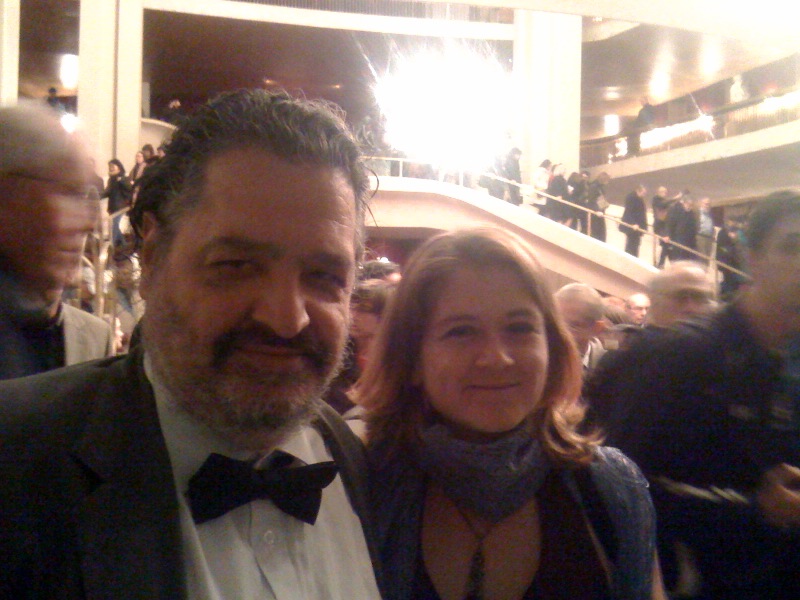
My friend was worried that I would renege again, but, as the picture below can attest, I did not.

Of course, when my loving ex saw the picture, she couldn't resist. "Aw, father and daughter. How cute."

When one of your friends and crew people is also a lovely opera and dinner companion for the evening, let them joke. It's certainly rare that I get to dress up, and there's joy enough in the charm of good company.

The opera that evening. The Tempest, by Englishman Thomas Ades, was written only a few years ago, and this was the first time I got to see a composer conduct his own work (in no small part because most of them are dead).

The opera was wonderful, the coloratura who sang the spirit Ariel being among my favorites.

The next week, my producer friend had another spare pair of tickets, this time to Verdi's Un Ballo en Maschera.  This was a more old-school production, but again, marvelous voices.

Two wonderful evenings of entertainment in return for a small discount. Not bad at all.

Of course, I hope that the general work environment does not become one in this digital age where barter becomes the norm, but heck, I can't complain. I didn't even have to lick any stamps.


Wednesday, November 21, 2012

When Production People are Extras

How Far Will This Mom Go To Protect Her Turf?: Watch this video of a mother in her natural habitat trying to save a seat on nickmom.

Sometimes, they rope you in to being in the shot. I was line producer on a series of pilots for Nick Moms.

In this episode, myself and my long time First AD Brian Bentham are the two "Dads." Much like on set, Brian is the real star and I'm just a supporting player - the guy in the mustache and beard trying to act in the last row.

To paraphrase My Cousin Vinny - yeah, we blend.

Monday, November 19, 2012

Producers Can Bake - To Help Others


Back in March, I told about an old boss of mine, Dave Tuttle. Dave had a long and successful career as a line producer before becoming a key figure at Gun For Hire, the production arm of Shooting Gallery, and a big part of that company's success (and no part in the part company's subsequent failure).  Dave will be featured in a documentary about Shooting Gallery's meteoric time, titled Misfire: The Rise and Fall of Shooting Gallery.

I said in that original post:

" Dave Tuttle was a former producer and line producer who conceived and led  Gun For Hire, and there wasn't a person who worked for him who didn't rave about the experience.  He disproved the idea that good guys finish last, or that you could either be good and efficient or a nice guy.  Dave was both, and in late 2000, he hired a guy who had been through the indie line producing wars and was ready for a "real" job - me.

I was almost 43 then, and probably older that what the position suggested.  Dave didn't care; he saw what I would bring to the job.  Ageism - and every other ism - is alive and well in the film business, but Dave looked past it."

I also said that Dave was the best damn boss a person could have.

This post adds little to the film part of the story - my apologies to those who only come here for indie film stuff, which I usually try to provide. It does talk to that great boss - and person.

As that article and a CNN report told, Dave now makes a living selling pies. It does well for him because he makes great pies with a lot of love, but certainly has not made him rich.

Thanksgiving is without a doubt the biggest time of year for pie makers, the time when their steady flow of income becomes a flood of income that will cover the slow times for a small business owner.

At a time when others would be cleaning up - and who can blame them - Dave decided to give back. While this should not surprise anyone who knows him, it is more than a token gesture. It gets to the heart of giving.

Dave posted this recently on his Facebook page:

"After speaking with friends who brought meals to those so severely affected by Hurricane Sandy and her aftermath, I decided that I too must reach out to those who lost so much and still lack the basic necessities including daily hot meals and comfort food. I have decided not to bake pies for sale this Thanksgiving, instead my family and I will bake as many pies as we and deliver and serve them on Thanksgiving Day to our neighbors in need. I know many of you may be disappointed that you will not have your pies on your Thanksgiving table however I feel this is something I must do. I am thankful for your continued support and thankful that I can help those in need of comfort."

Dave lives in Upstate New York, and had friends and neighbors who were hard hit.

On Thursday, though, Dave will be venturing from home to donate some of those pies he is donating to a warming tent in Far Rockaway.

I was displaced for two weeks by Hurricane Sandy. A writer/director friend of mine was out of his home, with his family, for the same amount of time. I know many across the film community in New York who were put out, including a location manager and college buddy who had severe damage to his longtime home. Some are still without power.

Hurricane Sandy was no small inconvenience. Although some would like to act as if it is over, it is not for many of my colleagues, not to mention so many others.

As heat and hot water have not returned to my place, I'm writing this from the home of a long-cherished colleague and crew member, who has generously opened up her home with no reservations for me. For all the pain this storm has brought, it has also brought out the good in people. I have seen so much unselfishness, and it's truly heart-warming to know that those you work with are truly friends.

Here is a chance for you to do something good as well.

Besides  those pies Dave is donating, someone suggested that people could "sponsor" pies, so as to help even more people.

Dave posted how to do so below. If you can find it in your wallet and in your heart, I hope you do so. It's called comfort food, and many people can use a little comfort this year.

I will try to spend part of my time as a volunteer for those displaced.

May all of you have a wonderful Thanksgiving.

Hello Friends, What a great idea, "sponsoring pies" -great way to pay forward - over 20 pies sponsored and counting. Many of you have asked where you can send a check for your sponsorship here's the info:make checks payable to Dave Tuttle, 94 Grand Street #5AA, Croton on Hudson, NY 10520 . We are all in this together!


Friday, November 16, 2012

Opposites Oppose - Part 3 - The Actress Sabbatical


"I used to be Snow White...but I drifted"


There is no actress in the history of cinema who is more quoted on the subject of sex than Mae West, who spent a career dodging and finding ways around censors.

After years in vaudeville and on stage, her first film role came in the 1932 gangster film Night After Night, at the urging of her friend, George Raft. According to her bio, she had a good deal to do with how her role was re-written and directed, including one of her more memorable lines, in response to "Goodness, what beautiful diamonds."

"Goodness had nothing to do with it," she famously replied.

Few remember that when she made that notable film debut, she was 39 years old. That's right, 39 years old. In film after film for a decade or more afterwards, she continued to play a sexual object of desire.

Marlene Dietrich made her film debut in Germany at the age of 21, but her Hollywood debut at the age of 29 (Morocco), and was noticed for her roles as prostitutes in Dishonored, Shanghai Express and Blonde Venus. She, too, continued to play sexual creatures well into her late thirties and early forties.

Yes, the role of ingenues have always gone to women in the early twenties, sometimes a little younger, as with Lauren Bacall's sexy 19-year old performance  in To Have and Have Not. However, Hollywood in the early studio days assumed that their male audience would be attracted to women, and didn't think it odd to cast women in their thirties or even older as sexy leading ladies.

Today, there are better roles for women once they get past their early twenties, but still not near as many as there are for men. They hit what I call "The Actress Sabbatical."

You know it when you think about the careers of the current "hottie" actresses. Some young actress will seem to be the hot love interest in almost every film for a certain period - Salma Hayek, Jessica Alba, Halle Berre; before them Charlize Theron, Uma Thurman, Cameron Diaz. Then, suddenly, without notice, their appearances become a little scarce, until the point at which they play - sigh - the "other woman", or worse, the "friend."

I call this transitional period from ingenue to character actress "the actress sabbatical," as if there were some lush island nation where they are allowed to tan and wait for more mature roles to arrive.

These are for the stars. For everyday working actresses, and especially indies, they go from playing the girl in the nude scene to the "young mother." As someone who has many actress friends, that first offer of a "young mother" can be chilling. It means that casting directors no longer keep your photo in that pile of "hot," sexy actresses.

This is not to say their are no roles for women being love interests into their thirties and beyond; certainly there are. Today, though, we have actually developed new terms for them, "MILFs" or "cougars."

Reviewers seem genuinely surprised when someone like Diane Lane can actually be seen as sexy and a little older, sometimes - heaven forbid - being attractive to younger men.

Meanwhile, as actress Greta Scacchi (The Player) once said, "Hollywood will accept actresses playing ten years older, but actors can play ten years younger."

The double standard hardly needs much explanation, and is hardly new. Indeed, one of the more famous screen romances, Bogart (44) and Bacall (19), would not have happened if not for the constant pairing of older men as appropriate suitors for younger women. While I would never suggest that Cary Grant or Clark Gable or any of those folk were not dashing into their older years, it's not like female stars of the same stature were always afforded the same luxury.

If some were to suggest that younger women are naturally attracted to older men, let me share this story. I loved the movie Atlantic City. For those who may not remember the 1980 Louis Malle film, Burt Lancaster plays an old, ex-gangster named Lou who helps a young croupier, played by a (then) young Susan Sarandon. Well, Lou wasn't quite the big shot gangster he imagines he was; not really a hit man but a marginal numbers guy. Still, he offers his protection, and even at 67 years old, Lancaster was still charming.

I was in college at the time, and mentioned to my date that it was absolutely believable that Lancaster and Sarandon (then 34) would have a brief sexual encounter. Her response can basically be boiled down to one word: "Eew!" further dispelling the notion we males like to foster as we get older that women find age attractive.

All of this is by way of talking about one of the more interesting aspects of my return to SOC.

One aspect of the movie features the lead character, a young woman bored with her life and trying to find something new, in a relationship with a nihilist older theater director, played by one of New York's wonderful character actors. In one scene, she finds herself in a threesome with another woman and this man. We will call the actress playing the other character Eve.

When I looked it up recently, I was surprised to find that when SOC was shot, Eve was in her early forties. Fit and attractive, she could easily have passed for mid-thirties. In her younger days, her good looks and figure had led her to roles as dizzy blondes, even though she was quite the opposite. In addition to one noted film appearance, she had established herself in many Broadway and Off-Broadway musicals as a fine singer.

Z hired her for her talent, not just her looks, and since there was nudity involved in the scene, he offered her early on the option of having a body double as the type of courtesy he might offer a star of any age.

She would hear nothing of it, insisting on the integrity of the role, and maybe just a bit because she rightfully was still very proud of her fit body.

So it was that I arrived on the day of shooting that scene to find the crew standing around in the hallway. It seemed that Eve was complaining about the work of the make-up artist and the body make-up involved.

The old stage manager in me quickly figured out that the problem was not with the make-up artist, nor necessarily with Eve doing a scene with partial nudity, but doing the scene where the other woman was somewhat younger.

This might seem vain to some, which is why I opened this article with an explanation of what it can be like for actresses getting even slightly older (I refuse to call anyone of any gender in their mid-forties "old"). Because of my experience in the area, I spent about twenty minutes talking with Eve, after which everything went fine, and she is wonderful in the final scene.

Veterans will tell you that nude scenes are far from titillating on a film set; they are cause for problems. To properly protect the actors privacy, they are closed sets, meaning only essential personnel can be in the room. This means that anytime you need someone else in the room - a grip or electric to make an adjustment, a prop person, etc - time is taken to get everyone covered up, then the person, who would normally be right by, is summoned, they come in, everything resets. There is little sexy about taking more time than usual to get a scene done.

Additionally, the First AD has to take time to think about when to schedule it. After meals is always a bad idea, for some reasons the reader can imagine. Late in the day, the actors may be tired. First scene of the day, which is my preference (so it can't wind up getting pushed back to past lunch) means a slow start to the day.

I should again note that the problem was not one of Eve being concerned about showing skin, but rather the specific situation. The problems I've had with nude scenes have almost always been with actors, who are asked to show much less, rather than actresses. We men often talk about women's vanity, but from my experience, male vanity is a much bigger problem.

It is also a comment on our business that women feel routinely required to disrobe at some point in their career, where men consider it a special occasion. Think about it. How many times have you watched a "morning after" scene where the woman steps out of bed topless or completely naked, only to have the man remain safely under the cover.

In other areas, Eve was not shy about her body. We were filming at night in the Meatpacking area of Manhattan at a time when it was not a place for chic restaurants and clubs, but rather for cheap (and often tranny) hookers and crime.

Our set was a few blocks from holding, and Eve was hanging in holding a scene or two before she was required on set. She was dressed in very short cut-offs, a tight, skimpy blouse and high heels. This was her own wardrobe, not wardrobe for the set.

"I need to talk to Z," she said, as she headed for the door. "Eve," I said, "wait a second. I'll have the PA drive you over."

"JB, it's only two blocks. I can walk it."

I knew she was perfectly physically capable of doing the walk, but was concerned that her attire might attract unwanted attention. Certainly, Eve was not naive, but seemed not to be worried.

Watching out for my actors is always part of my responsibility, and although I was not acting as one of the producers, I knew what P, our AD who had asked me back, would think of me letting Eve walk to set under those circumstances.

I found a way to politely suggest that I never let talent "walk" without escort (a 1st team PA should always accompany talent in any situation when heading to set, so there is no confusion as to their whereabouts). As that PA was currently on set, I walked her over.

Eve has since crossed to other side of that "actress sabbatical," though more in television than film. Ironically, one of the places where an actress can transcend the bias against older women as sexual creatures is soap operas - ask Susan Lucci - and Eve started a recurring role on a soap in 2011.

Dealing with these situations with Eve was my only "producer-related" work on SOC after my return, the rest of my time dealing with the more mundane concerns of locations management, the details of which have faded from my memory. My time spent with the lovely and talented Eve remains one of my fonder memories of that period.

As I write this in 2012, I am encouraged that while we still have a double-standard regarding age and sexual attraction between the genders, that gap is closing, maybe even to the point where we get back, one day, to a time when a 40-year old Mae West could tell a 29-year old Cary Grant, "Come up sometime, and see me." (Yes, that is the correct line) and not be called a "cougar" or "MILF", but simply, an attractive woman.


Tuesday, November 6, 2012

Opposites Oppose - Part 2 - They Pull Me Back In


I know how Michael felt.

After I spoke to Z, I finished up some things I was working on, gave Matt the information he needed, shook hands, and agreed to follow up on some things at home. I expected I would visit the set at some point to say hello and see how things were going. After all, besides Z, there were people I knew or had helped bring on working on set, and I did want the project to do well.

There was a huge weight lifted from me. There are enough difficulties wo\rking on any project that personality and philosophical differences are not needed. I did not expect to be on set again until things were smoothly underway and I would not be a distraction.

Matt brought on a strong woman named P to AD. P - and she was actually known as that due to her long first and last name - was a perfect choice. She had been UPM and/or AD on some of the more important indies of the period. Soon, she had eclipsed Matt and was also a producer on the film.

She and Matt got along fine, as long as Matt did what she said. Not long into production, though, Matt's inclination to go for the cheapest option meant that P had little production support on set, and that was not going to work.

The call from "P" went something like this.

"JB, Z and I have been talking, and we think you could help us on set. Let me be clear about something; I don't need another producer. We have enough cooks. I need someone to basically location and unit manage, to make sure the day-to-day stuff gets done. If you don't mind getting your hands dirty, we could use you."

"Is Matt okay with it?" I asked.

There was a deep sigh, and then, "Matt has nothing to say about it."

It was clear who was in charge, and as we talked, Matt and I would have little to do with each other. I would be on set, and he would be in the office, which he preferred to set, anyway.

There are DPs who come up through the camera department, and DPs who come up through grip and electric. Similarly, there are line producers who come up through the office - office PA, APOC,  Coordinator, UPM, then line producer; and then there are those that come up through set - PA, 2nd AD, First AD. Matt was the former; P and I were the latter.

It worked for everyone. I had a lot of respect for P, and over the years, I've learned how to work with other ADs and UPMs, respecting them and letting them do to do their jobs and me to do mine. P and I would have no ego or overlap problems.

Two of the people I had recommended to the shoot were Joe and Jenny.

Now, Joe and Jenny were the Rosencrantz and Guildenstern* of many of my projects.  I had met them both on a previous nightmare project previously discussed, where Jenny was the perky new production assistant who drove me on a very, very bad day.

The two of them were cute, all-American kids, always chipper and smiling, the PAs who would always volunteer first when any task was at hand and then thank you for letting them do it.

Stacey had recommended Jenny in the first place, and Stacey and I often joked that we wished Joe and Jenny would just hook up already. They would smile and coo at each other, but we figured, to put it in teenage terms, that they had never gotten much past first base. They were actually stuck in an elevator once together for almost two hours, and emerged with not a smudge.

How they maintained their innocence working on film sets eluded Stacey and I. Then again, maybe we were wrong; maybe the two were insanely passionate lovers who hid it well on set.

Sometimes there is too much free time, and these are the things that come to mind.

I took a cab to set, and the first person I saw was Joe. He was standing tall on lock-up, alert as ever. He perked up as I got closer.

"JB, what are you doing here?"

That was the first time I used the line from Godfather III.

"Just when I thought I was out, Joe, they pull me back in."

"Cool, JB, Cool."

As soon as cut was called, I walked past, and I heard him announce enthusiastically on Channel 1, "JB is on set!"

I retained the associate producer title. but P and I were very clear on my duties. I immediately started getting crafty in order, seeing that trash was properly disposed of, sets were restored, and company moves went smoothly.

Yep, my hands were back in the dirt. I remember the first time I asked Jenny if she was ready to whisk first team to the next location on a company move, she replied, "Super copy that, JB!"

Ugh, still perky.

Then again, part of me hopes she has not grown into an old cynic like me.

There was something cathartic about getting back to my roots, handling the nit-picky little messy stuff, not worrying about big-picture issues like were we going to run out of money or make the day. P had those well under control.

Unlike Michael Corleone, there would be no pressure on my chest, no shortness of breath, no calling out to my brother. C'mon, I could never improve on Pacino's emoting, anyway.

In Part 3, some fun stories from the personalities of SOC (as I am referring to this film) now that I was back on set.


*While the reference to Rosencrantz and Guildenstern literally refers to the two messengers sent from the king to spy on Hamlet in Shakespeare's play of the same name, I have used this reference for years not as duplicitous fools but rather observers who watch without comment on the lunacy around them. I probably need to find a better literary reference, but it works for me, and I'm not ready to change yet. Suggestions welcome.