
Showing posts sorted by relevance for query script supervisor. Sort by date Show all posts

Wednesday, March 7, 2012

Priorities - Coverage

There are points in the chronicles of the films I've worked on that I think it's appropriate to address a production issue at greater length, or expand on a point made in one of the production posts.This will be one of those posts.  I refer to these posts as "Priorities," the things we need to focus on in production.  As I brought up our script supervisor's participation on The Bet, I thought this would be a good time to talk about the work of script supervisors.   


The digital age has brought many wonderful advantages to aspiring movie-makers, but the reduced budgets have also led to breaking some things that were not broken, and they need to be fixed, among them an understanding of coverage and respect for the position of script supervisor.

They used to say that low-budget films are often set apart from their bigger brother counterparts by poor sound, but that is less and less of a problem even on no-budget sets.   As budgets have shrunk, budget priorities have become skewed, with money spent amply, and sometimes foolishly, in certain areas, to the  neglect of others.

Let's get one myth out of the way here and now - if you screw it up in production, it's highly unlikely you will be able to fix it effectively in post, and it will cost you more and not be as good as  if you had gotten it right the first time.

In the last post on The Bet, I mentioned that our brilliant script supervisor, Christine, was an integral part of the discussion on how we would shoot scenes.  We worked on some small budgets, but we would never think to save money with a less-than-experienced script supervisor.

Mind you, we were shooting film, so we had to worry about the cost of raw stock, and printing and developing, so making sure we had the right amount of coverage but not so high a ratio that we were wasting film was all part of the mix.  The script supervisor is essential in this process.

The completed project on The Bet is a testament, in no small part, to Christine's great work, and the work Matt, the director of Lucky Stiffs, did as editor.

Today, I see countless ads for "First AD/script supervisor" - two positions that are completely separate and cannot be done properly together.  On other sets, the script supervisor is whatever unpaid intern agrees to do it, often the person with the least idea of what coverage is needed.

I spoke with an actress making the transition to production recently.  She was hired on a film as a PA, moved up to production coordinator and asked to take script notes on a feature.  She had no idea what coverage was, but just wrote down what someone else told her, someone with as little understanding of coverage as she had.

Coverage has always been tricky.  When I made the transition from theater to film, coverage was the biggest mystery to me.  I could understand how to stage a scene, and how the master played, and could understand a few close-ups, but the range of coverage was something it took me years to fully comprehend.  It saddens me,then, that people who bring significantly less experience to the table think they understand it, and that they don't need any help.

I advised on a short about a year ago where the director talked endlessly about shooting like Scorcese and movement.  When the producer showed me the rough cut, I asked about shots that seemed to be missing.  The producer's answer over and over again was  that we didn't have that angle, or that the one take of that angle was bad.

This was not for lack of money.  Indeed, the director of photography could not have spent more on the equipment rented, insisting on anamorphic lenses and, when we discussed shooting on the 7D, which was more in line with the original budget, he said the crew wouldn't feel the movie was as "important" if it weren't shot on the RED.  The RED is a good system; the reason for renting it shouldn't be to impress the crew.  I hear this sort of nonsense endlessly.

So, he had his lenses, and a huge lighting package, and his RED, and then went out and got way too little coverage.  This for a director and DP who could not make one day as scheduled, despite a very talented and more experienced AD who tried her best to move them along.   The script supervisor?  It was a friend of the director's from when he was in school - when he showed up.

I mentioned that there is a balance between over-shooting and not getting enough coverage.  Even on movies where I've seen not enough coverage, I've seen tons of footage shot.  They were often in long takes, or endless takes to get the shot right, or angles that seemed like coverage but didn't cut so they left the editor in an either/or situation , not really more choices.

Let me repeat: the fact that you exposed a lot of footage does not necessarily mean you have enough coverage.

I find it ironic that in an age where the cost of raw stock, printing and developing is no longer  a concern for the very low-budget filmmaker, micro-budget films seem to suffer from a lack of coverage.

To move efficiently, I try to explain to directors that you are either looking at multiple takes or multiple angles, and on low budget films, you don't get both.  That means if you have carefully thought out your coverage, and your DP and your script supervisor both see it as sufficient, you are doing as many takes as you need to get few angles right, or you do enough angles that you will have choices when one angle isn't perfect.

Don't only try to cut in your head - the beauty of movies is that it is not necessary.  Your shot list or storyboard should not represent the only possible way to cut the movie, it should be your guide to choices you can make later.

If there is one mistake I can keep low-budget movie-makers from making as they read this post, I would suggest that they take the role of script supervisor seriously.  If you really feel you cannot afford this position, then hire your editor before the shoot and have them do the position.  This isn't optimal, but it's better than the alternative.

I have had the honor and privilege of working with so many amazing script supervisors.  They contribute so much to a completed project, and as producer, line producer or AD, I always consult with them and listen to their opinions.  In an earlier post, I mentioned a movie where the producers could have known on Day 3 that they needed to make cuts to the script; instead, they ignored the script supervisor's advice (and mine) and wound up cutting more than half the film after shooting it, at a great cost.  The Black Box.

All of this is not to mention the obvious advantages of having a script supervisor; avoiding continuity errors and saving time when editing because you know exactly what you have available in any given scene.

Now that monitors are pretty much WYSIWYG, scriptys can usually be found in video village, that wonderful cove set aside for monitor and key crew to view it.  Back in the day, even though we had monitors, script would always try to position themselves somewhere immediately behind camera, so that they could see the action from the same angle as camera.  This often meant script supes doubled as contortionists, cramming themselves into whatever small, hidden space they could find that was not in shot and did not throw a shadow, all while timing the shot and writing away.  Today, we don't spend as we used to on Polaroid film from that angle for continuity, but, of course, use digital, but those images are still quicker for script to have than constantly going back over footage to check which hand the cigarette was in.

They provide both lined script, showing that each and every line of the script is actually covered and from what angles (below right), and script notes, (below left) showing director's preference on takes and any issues or problems with those takes that were done.
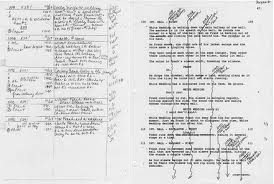


Of course, when shooting 35mm film, this helps in terms of knowing what takes to print and which ones not to print, which saves money.

When wrap is called, the script supervisor's job isn't done.  Many will type up their notes - I know Christine always did - to make them easier to read.

Everyone brings a special craft to the set, but because people see this one person seemingly just sitting and writing, I often feel they aren't given their due in terms of their importance to the final picture.

Long-time pros, of course, know the value of a good script supervisor, and for them, most of this post seems obvious.  The point of these "priorities" posts is to highlight some areas I see over-looked today, and to pass along some helpful advice to emerging filmmakers.  For those not in film who follow this blog, and want to know more about script supervisors, I direct you to the  Script Supervisor's Elevator Speech, a wonderful blog for those in any area of the business as well.

I've been in this business for more than twenty years, and if I were directing a project tomorrow, I wouldn't think of doing it without a good script supervisor.  No matter how smart you think you are as a director, or how good your DP is or thinks he or she is, a good script supervisor is a vital asset.

Respect them, and respect the work they do.

Okay, preaching over.  Next post, the reason why the subtitle to the tale of The Bet is "The Fall of Love."

Andrea, one of many talented script supes I know


Tuesday, January 24, 2012

When JB Met JR - Part 2 - Through the Walls and Over the Bridges

Walls and Bridges was my first feature as a First AD, and it held its share of challenges.  For what would become the norm rather than the exception, I was working with a first-time director, Uzo, who previously had established himself as a talented print art director.

Some films push the envelope; Walls and Bridges didn't even have an envelope.  The story revolved around a successful African-American commercial artist who has a moral dilemma around the work he is doing with his clients.  He confides in a young White nun who works at a youth center. They fall in love, she leaves the Church and they get married.  His family does not approve, and complications ensue.  At one point, when she is in the hospital and pregnant,  they get into an argument and he hits her.  It isn't in any way indicative of their relationship, but if you want to challenge an audience, have the Black husband hit his pregnant White wife who left the Order to be with him.

Many of the scenes were highly-charged, and I still remember trying to calm a hospital administrator who asked what the scene was about while we were working in a vacant wing not far from a working wing of the hospital.

"Screaming?  Oh, yeah, she screams, but not for long.  Why? Um, they have a disagreement."

When dealing with locations, you try to be truthful, but deal in the truth they can handle.  We knew we wouldn't have a lot of takes of the blow-up before we would get shut down or at least severely restricted, so it was a rough day.

There were other rough days, like the night we were filming on a street corner in Harlem.  We had police assistance, but a crowd did gather around.  I had  the following conversation with a guy who came up to a corner we were blocking off to film a scene where the lead character, Trent, is shot.

HIM: "Hey, what are you guys doing?"
ME: "Just a little movie."
HIM:"Really?  How long are you going to be here?"

It turned out the corner we were filming on was "his office," as he described it.  I did the math quickly, and made a snap decision on what his business was.  I informed him that we would be there all night, accompanied by the police, and maybe he wanted to take the night off.  In the process of talking with him, I shook his hand, and put a $20 bill in it "for his inconvenience."  Did I have to do that?  No, but I found that you get more with honey than with vinegar, and $20 was a small price to pay for him walking away quietly.

He thanked me, and seemed to get it.  Then, he turned around, and said that he didn't like to take anything for free, and that he could give me $20 worth of what he was selling, and that maybe I would buy more?

Was he kidding?  No, I wasn't interested in buying drugs, but thanks very much, now go away.

He got really upset.  What did I think he was selling?  I told him I didn't know, but I probably didn't want it on me, and hey, I said jokingly, I'm working and don't indulge when I work.

"Hey, man, you think I sell drugs?  You think I'm some crack dealer?"  I assured him I didn't know what he was selling.  He proceeded to pull out a pocketful of small pieces of paper.  On each of them was a pre-paid telephone card code.  What he sold, you see, was stolen credit card numbers and stolen pre-paid phone card numbers (this was a big illegal business pre-cell phones, when people depended more on pay phones).

He emphatically made the point that he only sold these (albeit, stolen) card numbers, and would never consider selling drugs.  After a short speech about the evils of drugs and the pariahs drug dealers were in the community, he handed me two slips of paper.  "They're worth ten dollars each," he said angrily.  "I don't take no hand-outs."  With that, he walked away.

Got to admire a man with principles.

Later that night, we were rehearsing a scene where a gun is fired.  When we did the first run-thru with the prop gun, one of the onlookers behind the barricades yelled out, "damn, my piece is bigger than that."  How reassuring.

After some initial problems, we actually hit a good speed at one point in the shoot.  We had an incredible sound recordist named Bill Kozy, who, while he is still an excellent recordist today, also does quite a bit of theater and film acting work!

My favorite joke with Bill was that "sound isn't important in this scene."  We all have heard the lies that men tell women; two of the biggest lies told on set are "sound is not important in this scene," and "we'll fix it in post."  Those words are always said by people who will definitely be nowhere in sight when the problem comes up in post.  Bill was the first of many talented sound recordists I've worked with, and the difference that it makes in post is immeasurable.  One of the biggest things that hold up small indies is bad sound, and the cost of fixing it in post is so much more than taking the moment to get a wild track or get that room tone on set.  Bill was great at working with me to move on when we needed to move on, and to be insistent when that was needed.

Still, I got a great deal of pleasure out of playing with him and telling him that sound was not important in a given scene, where he would make a sheepish face and say, "aw, don't say that JB."

The other lie, that "we will fix it in post" is told to the script supervisor.  I dare say that there are "gorilla filmmakers" (I HATE that term - more on that in later blog post) that have never dealt with or understood the value of a good script supervisor.  The job of the script supervisor is both creative and clerical, big picture and minute.

Of course, when it isn't "fixed" in post, and a character's scar moves from one side of his face to the other, or the cigarette he is smoking magically gets longer, it is the script supervisor who is left cringing at the screening.

We had an exceptional script supervisor, Christine Gee.  Christine went on to work on numerous projects - she was the script supervisor for the run of The Sopranos, among others.  She also taught script supervising at Brooklyn College.

Christine often functioned in an unofficial role as den mother; always available for help when needed, a source of encouragement, and also, when needed, a stern voice of reason.

Christine was the first to point out that we were shooting too many entrances and exits that would later get cut - she was correct.  This was part of the big picture.  I think it was during discussion with her that JR, or someone, referred to the film as "Entrances and Exits."

When we shot those entrances and exits, though, Christine knew every detail.   Remember that we were shooting film, so we had no instant dailies.  One day someone gave the address of an adjacent house as one number, and Christine said it was a different number.  "I can check my notes, "Christine said," but I don't have to.  I know its (this number)."  The other person wasn't so sure, and wanted to bet on it.  Christine was sure.  When dailies came back and her instinct was confirmed, she didn't gloat - just quietly put her hand out for the bet to be paid.

Small picture.  We didn't question her very often after that.

My time on that film, and others to come, made me something of a traditionalist.  In a digital indie film world now where jobs can overlap departments and directors sometimes don't even realize what each position does, (I am so sick of seeing notices for an AD/script supervisor - they are totally different jobs!) I was fortunate to work with a great staff and crew on modestly-funded projects.

The next blog post will finish the story of Walls and Bridges, with a lesson in one of the unpleasant parts of production.

(N.B.  As I post this today, it is Christine Gee's birthday, so, for the first time, I will make this the Christine Gee Tribute Post.  Happy Birthday Christine!)


Sunday, December 29, 2013

The Unattainable - Part 3 - The Seat of Wisdom

Scripty Extraordinaire Melissa
"She comes in colors everywhere,
She combs her hair
She's like a rainbow.
Coming, colors in the air
Everywhere
She's like a rainbow."
-She's a Rainbow, Rolling Stones

My admiration for script supervisors was made clear in a previous post. When it came time to hire a script supervisor for The Unattainable, I reached out to Andrea, who is pictured in that post.

She was not available. I explained the complexity of the script; that we would be shooting in digital and 16MM, that the script would be broken down into present, past and voice-overs that were part of the lead character's imagination.

She gave me one name - that of our scripty above, Melissa.

I spoke to Melissa briefly, and then sent her out our latest copy of the script at the time.

At the time, we had not published a script, which was undergoing constant revisions, and continued to do so right up until and after filming.

In order to keep track of changes in all paperwork, starting with the script, a color code is used to distinguish revisions. In the case of the script, the line producer, AD and script supervisor will confer on whether the changes are few enough to just color code certain pages, or go to a new color entirely.

The guide we used was: white, blue, pink, yellow, green and goldenrod. The standard color code includes more colors, but in order to save us the cost of buying even more reams of different colors (remember, this same code is used for paperwork such as schedules, vendor and crew lists, etc) I cut it off at Goldenrod.

Coming, colors everywhere. It is, indeed, like a rainbow, with a wash of different colored paperwork.

This being a very low budget project, I had originally budgeted one day of prep for script supervisor, which clearly was not going to work with our complex script.

For one thing, there was establishing a timeline. Designers needed to know what happened when, hair and makeup needed to know if this was our leads now or five years ago, the AD needed to schedule so as to not constantly having us change set dressing and the rest during the middle of the day.

The director had a very clear timeline, and it was laid out on index cards along one of her walls. She would show it to anyone who wanted to reference the timeline. When I say it was laid out on a wall, it was an entire wall, floor to ceiling.

The prospect of carrying around the wall was, well, not very enticing. We needed something simpler.

We needed the right person. After getting Melissa's initial response to the script, I knew she was the right person. I knew we had to have her, and looked to get her together with our director as soon as possible.

Below is a somewhat edited and redacted (national security, proprietary information, and all that - very hush hush as they used to say in the spy movies) version of her first email explaining how she broke down the script.

I have attached my Short Form Breakdown by Scene Number below.  .  Everything after Sc11 is supposed to be chronological 

A few notes: 
1952 = Harry's birth year
1970 = Harry goes to Vietnam
1956 - 1975 = Vietnam War
10/1/2000 = FEMALE & Kevinbegin dating
10/15/2003 = Our story begins (Sc31)
2004 - 2006 = FEMALE & KEVINPAST
2010 = FEMALE & Harry's PRESENT

I will fill in the other details later.

Please let me know if you have any questions/comments/etc.

Best,
Mel


Here is the chronological list that (directors assistant) made yesterday:
LIST OF SCENES BY TIME
PAST: (x)scenes
PRESENT:(x)scenes
ATEMPORAL/IMAGINATION: (x)scenes
TOTAL: 124 scenes


The Short breakdown she refers to starts like this

Scene Location Characters D/N Date Time 1/8s ERT

Scene Location Characters D/N Date Time 1/8s ERT

Scene Location Characters D/N Date Time 1/8s ERT

1 EXT. DOCK BY THE SEA (FLASHBACK) - AFTERNOON D10 Sat-10/08/2005 12:36P

1 EXT. DOCK BY THE SEA (FLASHBACK) - AFTERNOON D10 Sat-10/08/2005 12:36P

1 EXT. DOCK BY THE SEA (FLASHBACK) - AFTERNOON D10 Sat-10/08/2005 12:36P

2 INT. PRISON VISITING ROOM (FLASHBACK) - DAY D11 Sun-10/09/2005 2:10PM 2 5/8 2:37

2 INT. PRISON VISITING ROOM (FLASHBACK) - DAY D11 Sun-10/09/2005 2:10PM 2 5/8 2:37

2 INT. PRISON VISITING ROOM (FLASHBACK) - DAY D11 Sun-10/09/2005 2:10PM 2 5/8 2:37

3 EXT. DOCK BY THE SEA (FLASHBACK) - DAY D10 Sat-10/08/2005 1:43PM 2/8 0:15

3 EXT. DOCK BY THE SEA (FLASHBACK) - DAY D10 Sat-10/08/2005 1:43PM 2/8 0:15

3 EXT. DOCK BY THE SEA (FLASHBACK) - DAY D10 Sat-10/08/2005 1:43PM 2/8 0:15

4 CREDITS OF FILM Z 1/8 0:08

4 CREDITS OF FILM Z 1/8 0:08

4 CREDITS OF FILM Z 1/8 0:08

5 INT. APARTMENT, EAST VILLAGE, NYC - DAY D17 Mon-09/20/2010 3:43PM 7/8 0:53

5 INT. APARTMENT, EAST VILLAGE, NYC - DAY D17 Mon-09/20/2010 3:43PM 7/8 0:53

5 INT. APARTMENT, EAST VILLAGE, NYC - DAY D17 Mon-09/20/2010 3:43PM 7/8 0:53

6 INT. BAR (IMAGINATION) - NIGHT Z16 Sun-09/19/2010 10:33P

6 INT. BAR (IMAGINATION) - NIGHT Z16 Sun-09/19/2010 10:33P

6 INT. BAR (IMAGINATION) - NIGHT Z16 Sun-09/19/2010 10:33P

7 EXT. HALFWAY HOUSE - NIGHT N16 Sun-09/19/2010 11:28P

7 EXT. HALFWAY HOUSE - NIGHT N16 Sun-09/19/2010 11:28P

7 EXT. HALFWAY HOUSE - NIGHT N16 Sun-09/19/2010 11:28P


This is a small part of the work Melissa did.

As we moved forward, Melissa's understanding of the script became crucial to every aspect of the shooting, and I have to say she was more involved in helping to get coverage and tell the story than most supervisors I have had the chance to watch work.

One day in particular that I remember was our Day 2. It was all meant to take place INT THEATER. At one point, the DP got the idea of shooting one section EXT in order to break up the shots and give us an intro the those scenes.

What time of year was it? Was she wearing a coat? If so, how heavy?

As our first team was discussing it, Melissa calmly looked at her notes and said, "It's January 20th, 2011."

End of discussion.

Her daily notes continued to not only help for editing, but helped me know details about what was happening during the day that would have been impossible for someone else to keep up.

I've waited some time for script supes to get me notes in the past; Melissa's were usually within two hours of wrap. She gave credit to some software she said she was using - I think she secretly created the software and just didn't want us to know. After my AD, she was the second person I would seek out when I came to set to get a sense of what was happening.

As with most movies, the color wheel kept on turning, with schedule revisions necessitated by actor availability (we were sharing our male lead with a TV show filming in LA) and locations.  My small but incredibly efficient production office kept us constantly with the proper color, as "Megan, what color vendor list are we on?" would be answered with something like "Pink, but don't publish that one yet - we're still revising it."

I often wonder if we make making movies too hard, if we secretly enjoy it more if it's more of a challenge. Somewhere, people work with those simple, boring scripts I referred to in the start of this series. As my long-time AD once said when we were doing a complicated dolly shot through every room in a house on an Indian-American co-production a few years back, "JB, remember when people used to point the camera and shoot? What ever happened to that.?"

Maybe it's me, and I'm just drawn to more challenging scripts, having become numb to the endless stream of scripts that just regurgitate the same, worn-out plot lines and characters.  Indeed, sitting through trailers for upcoming films the other day, I wondered if I was in a revival house, watching movies that were just remakes of older movies, either clearly or inferred.

What I do know is that on this film, on this script, I was glad to have this lady.

"Have you seen her all in gold(enrod - my edit)
Like a Queen in days of old
She shoots colors all around
Like a sunset all around"

For this shoot, no, I have not seen a lady fairer.


Tuesday, May 6, 2014

We (Do Not) Have the Technology

"It is only when they go wrong that machines remind you of how powerful they are."
-Clive James

Once the technology to do something exists, there is nothing more frustrating than it not doing what you want it to do.

In preparing a short series on a software I truly like, Jungle Software, the makers of of Gorilla and other production systems, I was reminded of those instances of what happens when technology does not work to your advantage.

Case in point: On my last feature, the script was written in Celtx.

Yes, Celtx is free, and, as Stan used to say, oh, the high cost of free.

Understand that for many years,scripts were typed, schedules typed, call sheets hand-written, and stripboards were really strips of cardboard. That is all well and good, but once we moved on, we should never have to move back.

For me, the prime example of the "never go back" principle is the coffee cup lid.


One day, some bright person figured out that instead of having to tear open a portion of the lid randomly, the lid could be perforated to offer the perfect opening from which to drink.


Surprisingly, this patent suggests that the technology was created in 1980 - exactly 11 years after we put a man on the moon and thirty-five years after we harnessed the atom so we could kill more people more quickly. It seems the boys at NASA and/or the Manhattan Project, respectfully, could have figured this one out during one of their, well, coffee breaks.

What does this have to do with making movies, or Celtx, you ask? Making revisions and sharing.

I am not going to get into comparing every software option for screenwriting - and certainly there are a number of ways that work, including simple templates in Microsoft Word, but I think most people in the business would find Final Draft the most convenient software from both a script creation and, more importantly, production-friendly standpoint.

I have previously discussed the role of script supervisor and script revisions, so I won't repeat that here. On his wonderful site lineproducing.com, Stephen describes how to do revisions using Final Draft.

In the internet age, making revisions to any document and being able to share that document and those changes is important. Celtx made both of these difficult, even after we moved out of free mode and "upgraded" to some of their "premium" tools.

I am no tech whiz, and if it were just me, then I would concede a lack of sophistication with the software. However, the process stumped me, my production coordinator, my producer, and my First AD. It seemed at every step along the way, you could not, as they say, get there from here. You could do one thing but not the other You could do it on your computer but not share it. When even my aforementioned genius script supervisor could not do it, I broke down and hired a PA to retype the script into Final Draft, after which the revisions were simple and share-able.

This is not an attack on Celtx. This is the same frustration every time you discover that any advanced program (and I am not accusing Celtx of being an advanced program) does not do precisely what you want it to do, and it takes you longer to figure out how to do it than to have, say, just done it the old way. We encountered similar (but not nearly the same) frustration with Dropbox, and, to a lesser extent, Google Drive.

At one point, the director's email account was not properly receiving or sending emails, "eating" them, as we like to say.

Then there was the junction box we rented, which did not seem to get us wifi in some of the places we needed wifi.

These are, to be sure, Third World Problems. To use one of my favorite Hitchcock quotes, a child did not die. On the scale of progress of Mankind, these aberrations would have produced barely a glitch.

Still, once one gets accustomed to having these conveniences, being deprived of them seems all the more painful.

On the production side, there are certainly a number of companies that offer great software that save us time and effort, including EP Movie Magic, which I used to teach at New York Film Academy.

However, for a number of years, I have enjoyed using Jungle Software, which initially was just Gorilla, but has now grown to a larger family of production-related software. There are many reasons why Gorilla is the software I prefer, and I will explore those in a few posts where I interview Aaton Cohen Sitt, the President of Jungle Software.

Here's hoping that, until then, your version of Hal 9000 never says to you:

"Im sorry. I can't allow you to do that."


Wednesday, November 27, 2013

The Unattainable - Part 1 - That's Not What Productions Are Made for


The script for our feature is based on a novel; more precisely, a book of aphorisms.

Aphorisms have a long and distinguished place in literature, going back to the Ancients. Wiki describes them as "an original thought, spoken or written in a laconic( concise) and memorable form."

This original script had a few key, diverse characters who muse on life, and centered around a main female character who is a  writer. We will call her Justine.

Justine has two important men in her life; her ex-husband, who we will call Kevin, and her long-time lover, who we will call Harry. By the end of the story, she has found a third man in her life, a theater director.

She loves them all in one form or another, and each fills a place in her life. Together with some fellow writer and artist friends, she explores on the nature of love and relationships and why we do - and need to do -what we do.

All of this is beautifully laid out in the book. Presenting this on screen is slightly more difficult.

When I first read the script, I was intrigued by the wit and depth of insight. Many of the scenes were two or more characters presenting their struggles through these musings. The play had been originally scheduled for 18 days, at a modest budget (budget numbers always being confidential, even without an NDA). While it seemed a challenging schedule given the script pages covered, I thought we could accomplish it, as scenes with two to three characters talking, no stunts, etc. tend to be rather easy to film.

My first hint that this would not be the case was my first almost 3 hour meeting at a coffee shop with the director, A bright, organized, prepared woman with an incredible visual sense and background, she revealed her visual references. While there would be the literal action of the scenes, there would be sub-text, presented through voice-overs that were more "temporal," to use the words of my amazing script supervisor.

Every draft of the script improved the movie exponentially. Following Murphy's Law that No Good Deed Goes Unpunished, every improvement made the script more difficult to shoot. Additionally, the producers and director had hired an experienced Director of Photography with an ability to bring exactly this type of movie to life, but also wanting and needing the proper time to get the beautiful shots I have since seen in dailies.

Additionally, constant changes right up until beginning of shooting make the schedule a moving target; never a good thing for production.

Here is an irony I have learned from years of making movies. Boring scripts are easy to shoot. As someone who has budgeted 34 scripts in the past year, the easiest for me is when there are few characters in few locations mostly talking. For the line producer breaking down a script, two characters talking for 6 pages in one location - preferably something simple like a park bench or their apartment - means a quick breakdown, budget and turnaround of both.

It also makes for a movie most people will sleep through.

The nightmare in breaking down a script is many short scenes in many locations. You are adding many more sheets, and scheduling becomes difficult because of company moves and the difficulty shooting out performers.

This makes for a fast-paced movie people that will keep people sitting up in their seats.

So, there's the rub. Boring script; easy for production. Challenging, engaging script; challenging for production.

All this got me thinking of the quote from John Augustus Shedd that a DP friend of mine keeps in her room: "A ship is safe when it is in harbor, but that is not what ships are built for." It's the challenge we are always presented with, whether we realize it or not.

On this film, we are definitely not in harbor.


N.B. Because production has kept me insanely busy, I have not been keeping up the blog as I had hoped. With luck, I will catch you all up over this holiday break.


Saturday, February 18, 2012

The Black Box


In the wake of an airplane crash, the National Transportation Safety Board searches for the black box, which hopefully tells them what went wrong, and helps to prevent future crashes.

Movies are a little different. We have production reports, which should accurately detail how each and every day goes.  Good 2nd ADs and 2nd 2nds keep detailed notes, and I have always encouraged them to write it down, even if they aren't sure.  If I am the 1st AD, I will call out notes (privately on Channel 2, or as private as Channel 2 is when other departments aren't spying) as they occur for my 2nd, because I may not have time to write it down.  Better to have a record of it than not - we can always sort out later if something noted is important or not.

There are other clues I look for as line producer or UPM, also from the production reports.  Set-ups, of course, are crucial.  I also look closely at the script notes: how many takes are we doing, how long are scenes running, what does the coverage look like, and, if we are shooting film, how much film are we exposing.  All of these things can give you clues, but they don't give you the answer.  Much like the Black Box, it's all in the interpretation.  Thankfully, on a movie, you (hopefully) have live witnesses you can interview to get more information.

Unlike plane crashes, we try to analyze the crash while the plane is still spiraling to the ground.

It's amazing the little things you will notice from production reports, especially the script supervisor's notes.  For instance, I line produced a film where I noticed that, for a scene that would run, say, one page, the masters would run two minutes or more.  Hmm, no matter how you cut the coverage into the master, that means the scenes will run a bit long.  Not a big deal for one scene; definitely a big deal when it's every scene.  I had a first-time feature director who had done shorts and music videos and thought he could just fix it all in post.

After two or three days of this, I sat the writer/producer/lead actor, exec producer, and scripty down and discussed this.  Indeed, her timings, and the way we were running, would mean the entire screenplay would run over 4 hours!  The time to fix this was now.  We needed trims to the script, I needed to see better shot lists, and we needed to get this under the control.  The director blew it off, and the writer/producer was unwilling to cut anything from the script.

Long-story short: the film, which I left because if they won't listen to you, there is nothing you can do, was a story with a past, a present, and a future.  It ran almost twice the length of the original shooting schedule and triple the budget (yes, the line producer who replaced me was very competent and the AD was very good - there is only so much you can do).  Worse, the final film cut out almost all of the past and future and just used the present; they only used about 40 percent of the movie they shot.

This was all predictable and avoidable.  They wouldn't listen.

I choose this point in the blog to address this because of the problems noted on Lucky Stiffs, and the eternal question we have of why things go badly at times on film sets.  Like in a plane crash, there are mechanical problems (like the dolly mishap, or, on other shoots, REDS freezing - they like to do that).  Also as in a plane crash, there is often human error.

Note that I say human error, not pilot error.  Depending on how you look at it, pilot error on a feature film is either the director or producer.  On studio films, the producer can fire the director.  On indie films, the director often is the producer, so that's not going to happen.

Also like on a plane, though, it may be the pilot that seems at fault, but it may begin somewhere else, a mechanic missing something faulty in the working of the plane earlier, for example.  By the time gets the pilot, it may be too late.

The  Hollywood Juicer , in his wonderful blog, has a classic article called The Circle of Confusion, that shares three disaster flicks - the happenings on the shoots, that is - that happened earlier in his career.  He also notes his surprise, coming from it originally as a naive kid in film school to these Hollywood shoots, that professionals could make these sorts of mistakes.

In the indie world, we look at problems on set and bemoan our lack of money, or sometimes write it off to the smaller budgets meaning smaller or maybe less seasoned crew, but is it really that?  Francis Coppola, who produced one of the most successful and, by most lists, one of the best films ever made ( be it Godfather I or Godfather II - you choose - I know it wasn't Godfather 3), took American Zoetrope through some very shaky financial times, with film after film that went over budget and did not recoup their money.  Spike Lee, an admired filmmaker, went  over budget on Malcolm X and  the bond company took it over for a time.

I could go on, but clearly having talented professionals and boundless money does not solve the problem.  Why, then, are movies so damned hard to make?

I go back something Martin Scorcese was quoted as saying in the book, Scorcese on Scorcese.  I'm paraphrasing, but it was something to the effect that 'every time I come on set, and I see all these people and all this equipment, I think to myself, I'm not qualified to do this.'  Granted, this was shortly after he had close to a nervous breakdown but right before Raging Bull.

The point remains that there are a lot of moving parts, mechanical and flesh and blood, on a movie set.  We try to have contingencies for everything - cover sets for rain days, more than enough equipment if something goes down, etc.  It is even standard to build a contingency into a budget.

However, when you take all those mechanical moving parts, and add them to human beings at the control, the possibilities for delays and overruns are endless.  Oscar-winning actors can have bad days, where take-after-take may not work.  The hero car that got to set fine doesn't start.  The DP and director have the same idea in their head for the shot, but it just doesn't look like they drew it up, and a re-light is in order.  The art department ordered the prop in more than enough time, but Fed Ex broke it in shipping.  The costume designer is breaking up with her husband and her distraction is leading to sub-par costumes that have to be redone.

The human equation is not theoretical, and not so easy to determine.  I had two experiences hiring people who had previously been wonderful who turned out all wrong on another shoot.

A 1st AD who had just experienced the birth of his first child.  On our previous shoot, he was energetic and detail-oriented.  On this one, small things were slipping, and it culminated in a tech scout where he seemed to not know what scenes were being shot where.  It turned out the baby was keeping him up and he was getting no sleep.  One of the most unpleasant experiences of my career was this person whose wedding I had attended.  More on that in a future post.

The other was a location manager who had come on and saved a shoot I had taken over.  On this shoot, she was about three months pregnant, but assured me that it would not be an issue.  Once again, the blessed event of childbirth reared its ugly head to hinder the clearly more important task of making a movie.  Her mood swings made her impossible to deal with as a co-worker, and she wasn't finding us any locations.  Her foul spirit at the time made her termination a little more easy to bear.

If Dante was correct, I wonder what circle of hell line producers who fire pregnant women and fathers with newborns occupy.

Oh, and for the record, I discourage any crew or staff member of mine from quitting smoking during the course of our shoot.  I will gladly be supportive later; for now, smoke 'em if you got 'em.

Multiply these sorts of things times the 30-40 crew people on even a small indie shoot, plus the cast, and you get the idea of what human error can look like.

Certainly, all of this should lead us to despair, right?  Maybe not.

I have worked on far more movies that came in on budget than over budget.  I have worked on many films I am extremely proud of, including post supervisor on a movie shot in Cambodia on a 5d for less than $300K that looks like a million bucks just recently and films that have had major distributors and won major film festivals.

I told students that I learn on every movie I work on, and if you ever kid yourself that you have nothing more to learn, it's time to get out.  Each script is different, and has different challenges.  Your last film had lots of stunts, and you figured out how to do all of that?  Great, this film has no stunts but most of the cast are children.  Next movie is filming in the Gulf Coast during hurricane season, or animals abound, or you name it.

There is no cookie cutter, no template, no one-size-fits-all.  There are tried-and-true procedures, and you lean on them for all they are worth, because while there is no template, there is no need to reinvent the wheel either..  (Have I used up my quota of metaphors and analogies yet?  Now you know why I have trouble with Twitter).

What can you do?  It starts with taking time with the hiring process.  Find not only good and talented people, but people who want to be on this particular job, and are a good fit with each other.  The best DP in the world is not gonna work when you have a limited budget and he can consistently needs 60 minutes to get the shot "just right."  That AD might be very talented, but if his or her personality somehow doesn't mesh with the director, there are going to be problems.  We are humans, and we bring issues to the table.  In a business full of freelancers, otherwise known as people who have trouble with routine, authority and convention, let me tell you, the table is pretty overcrowded with issues.  I often say that my 'usual suspects,' my preferred crew, have their own issues, but since I know what those issues are, I find a way to work with them.  A good  team  means checks and balances, and someone will likely be there when an oversight occurs.

Some I have worked with might suggest I have issues, but I can't imagine that to be the case.  At all.  Really.

Those of us in production should be trying to find the right balance of rigidity and openness; no, I will not do something I have seen fail a dozen times before because you think it's a cool idea.  I believe in most of the conventions of film-making, and standard production procedures and practices. They have been developed over years, and those that stuck did so because they work.

There is, however, something to be said for the fact that you need to know the rules in order to break them.  There are times when the standard doesn't work or doesn't apply, and then you have to be able to adapt.

Hopefully, there will be more lessons along the way.  I will put out there all the things I know that work, and all those I have seen not work, so others can learn from mistakes already made when possible.  We will have a little fun along the way.  Stick with me, and you will learn everything you wanted to know about working with draft horses, snakes, the wonderful world of "mob actors" and a whole lot more.

Most of all, remember that the light at the end of every tunnel is not necessarily an on-coming train.  Matt, for all our problems, loved the final result of Lucky Stiffs.  Did you see that smile in the last post at the opening?  The same can be said for the people who made that movie where the final product was only 40 percent of what they shot; they got distribution and some nice reviews.  People don't tend to remember the days when everything went right, and, at the end, an audience  doesn't care, as long as the final product is good.

What if you are not the director or producer?  What do you have to look forward to on difficult shoots?  On even the worst shoots I have been on, I have met good people who I brought onto future shoots, good people who brought me onto future shoots, good people who became lifelong friends.  On other films I  learned something I used on future shoots.

Forget if the glass is half-full or half-empty and enjoy the water (ok, it's rarely water) that's in it.

Get all of that data from the black box, then get that next plane up in the air.  We have places to go and movies to make.

Sunday, February 26, 2012

The Bet (or The Fall of Love) - Part 1- Who Could Ask For Anything More?


Days can be sunny,
With never a sigh;
Don't need what money can buy.
Birds in the trees sing
Their dayful of song,
Why shouldn't we sing along?
I'm chipper all the day,
Happy with my lot.
How do I get that way? Look at what I've got.

"I Got Rhythm (Who Could Ask for  Anything More)"
George Gershwin


JR and I were sitting at the screening of The Bet, and one phrase stuck in our head; "What would you do for $40 Million Dollars?"


It stuck in our head because it was intoned by the voice over in the trailer in a deep, pretentious and ominous tone, almost a parody of screen voice overs.

"What would you do for FORTY...MILLION...DOLLARS?"

How did it all start?

It was August of 1992, and JR called me.  We had a gig.

Wait.  Does this sound familiar?  It's August, and JR contacts me and we have a gig for the Fall?  Starts in September?  Preps in Late August?  (Un)Lucky Stiffs - Part 1 - Bringing Up Baby

There are differences this time.  We are still working with JR's basic crew, though we have a new AC; Lorelei is not available.  Jeff and Russell, our gaffer and key grip, respectively, are on board.  JR, Stacey and I have dinner, and we talk about Stacey coming on as 2nd AD.  There is no doubt she is a good fit and can handle the job. Done.

This time, Stan and his coordinator, Dianne,  will be coming on board from the beginning.  This makes a world of difference.  This was JR and my third movie together, and we had done a PSA in between, and now we knew that production had our back.

The film was written and would be directed by a man named Adam, who lived on a nice-sized estate in the New Paultz region of Upstate New York.  We took a tour of his estate, along with his wife, Isabella, before bringing the rest of the crew with us.  Almost all of the movie could be shot on the estate; Adam had written it that way.

For an AD, this is heaven.  No pedestrians or traffic to lock off.  We control sound.  Complete cooperation from the people who own the property.  Ample area for art department to work.  No mass company moves.  Equipment will be easily and securely stored at night, meaning the 2nd AD was not stuck there forever.

Adam and Isabella were a charming older couple, Adam being 70 at the time.  He was an educator and widely published author, president of a society dedicated to the study of a well-known author, and expert in a number of areas of literature.  In our first meeting, I felt like this was someone who I could talk with endlessly, especially since we shared an interest in the author Joseph Conrad, in fact, the screen adaptation of Conrad's Lord Jim is on my short list of favorite films.    The better known Conrad adaptation, of course, is Apocolypse Now, loosely adapted from his Heart of Darkness. We shared a love of theater; he had written and directed a number of plays.  We shared a background and respect for radio; this and two other works of his had been performed as radio plays.

I remember heading back in the car to NYC from that first meeting thinking how idyllic and wonderful this shoot would be.  The cast and crew would have to be housed nearby, but I couldn't imagine that would be difficult.  Stan and Dianne had done some research and I had promised to come up and search out hotels or motels soon.

We would hire most of our PAs locally to save the cost of housing, and the art department were a boyfriend/girlfriend who were local.    We met Rick and Lorrie during our first trip, and they had already begun work on the project.  From the first meeting to the end of the shoot, it seemed that any time I saw Lorrie, she was in the middle of  working hard, dusting herself off from something she was either crafting or painting.  Effort was not going to be a problem with this art department.

Culling the best from everything we did, we brought Matt, the director of Lucky Stiffs, on board as the editor of this project, and he did a bang-up job.

We added some new people to our usual crew, some who would stick with us for shoots to come.  I sat in on the interviews with Stan and Dianne - they both were involved in the interviews.  As previously stated in talking about Stan and Dianne, Dianne was much more than his coordinator.  She was a trusted partner who offered a sounding board for Stan, and she could disagree with him when he wasn't seeing something.  This was later something I sought to surround myself with, either in my immediate support staff, or in a person in the position of "assistant to" the producers, or sometimes both.

This was part of my training as a producer or line producer.  Over the course of time, you will be called on to make many decisions, sometimes simultaneously.  We all bring our collective experiences and observations - more commonly known as our baggage - with us wherever we go.  It's good to have someone you can trust who is there to let you not follow your instincts when those instincts will lead you to mistakes.  The thing you will find about "yes people" is that when something goes wrong, they are nowhere to be found.

As an interviewer, Stan was a male Barbara Walters, chatting with potential crew members in a fashion that put them at ease, so he could get them to reveal more about themselves.  The resume pretty much tells you what they have done; the interview is to discover who they are.

Some of the new people included a bawdy make-up artist named Vera; of  "good Nordic stock", as she would say, Vera was a woman who was friendly and flirty and confident, blonde and statuesque.  She embodied what I would later look for in a make-up artist; which is this: any make-up artist I hire should be able to apply make-up well, it's the basic.  What most people don't recognize is that the make-up artist is  pretty much the first person cast deals with when they report to work.  If they had a good night or a bad night, if they felt good about the upcoming scene or not, if they had a pimple or scar that had chosen the worse time to appear, it's the make-up artists who is going be told first.

I want a make-up artist who can be the actor's confidante, but also know when to cut the conversation and get them on set.  They should be able to make the actor feel great.  They should also know how to protect the actor from the craziness of production, without making the first team PA (the PA with the responsibility of delivering actors to set) or 2nd AD the enemy.

Vera did all of this, and more.  She was my smiling face when I walked in the door, she would make sure my day started out well.  I felt like I was special to Vera, like she really cared for my well-being just a little more than everyone else.  Her magic, of course, was that everyone felt this way.

Vera would become a usual suspect.

We hired a local stage manager named Jane to be the 2nd 2nd AD.  I love me my stage managers, and having someone local was a good thing, someone who knew the area and could take care of things when we were away.

In today's budgets, the AD department is too often given the short end of the stick, and the importance of a 2nd 2nd, a good key PA, are lost.  If producers find the money for a good 1st AD, they then think that anyone can be thrown in as 2nd AD, and 2nd 2nd and Key PA seem like luxuries to them.  There is a reason there is an AD department, and the AD can no more do their job without a good staff than a Gaffer would want to work without a trusted Best Boy.

Another one of JR's sound people, Larry, came on as recordist, and he brought a young, virile kid named Chris as his boom operator.  The significance of this will become clear later.

Christine, our incredible script supervisor, doubled as wardrobe supervisor, with the costumes designed mostly by the art department.  Christine heading the wardrobe department while doing script may seem strange, but she requested it.  She had started her career in wardrobe, so she was more than qualified, and this gave her more creative input.  Her creative contribution in other areas would be even greater as filming went along.

Her assistant in wardrobe was a pleasant, pretty young girl named Sonya.

The script is based on a short story of the same name by Anton Chekhov, which has actually had a few screen adaptations, usually as shorts.  The best well-known one may be this one with Robert Prosky.


This script adapted the story to America.  The basic story line is this; at a costume party, a wealthy businessman makes a wager with a young law student that he will not be able to spend ten years in prison, and if he can, he will get $10 million, which can balloon to the aforementioned $40 million with investments .  This means the young law student must risk losing his pianist girlfriend.  There is a mix of fantasy and reality, and a reversal of fortune.  For a small film, there were lots of elaborate costumes and special effects, and we all wanted to make sure the look was realistic and not cheesy.

I was one of the few members of our regular crew that was married, but Maureen understood perfectly that there would be times the job would take me away on business.  As Adam was older, we didn't try and shoot six day weeks, as we often did to save money.  This meant I was home for the weekends.

We weren't working 9 to 5, but this was about as close to being on a gig came to being a "normal" job.

Fall is a lovely time in areas like New Paultz.  It has some of the feel of a college town, so there are the newly arriving freshman.  The smell of the Fall always brings me back to my early days at NYU, walking through campus.   The estate was beautiful, and there would eventually be the turning of the leaves, that slight chill in the air that took away the oppressiveness of August humidity.

For NY crews, shoots like this can be a little like summer camp, for better and for worse.   You have to stay on top of them a little bit more because it's too easy to become complacent and relaxed and distracted.  Oh, look, isn't that deer nice?  Look, his doe is following him, how cute.

Hey, we're working here, okay?

In the back of my mind, I knew this was something to keep an eye on.  Still, with everything we had going for us, it seemed manageable, and, after all, this crew always worked hard while still being able to have fun.

Peaceful surroundings, nice people to work for, our usual suspects and some promising new members as crew.  Who could ask for anything more?


Wednesday, May 15, 2013

Double - Part 2 - The Tao of Exposed Film


"There is no greater misfortune
than not knowing what is enough
There is no greater flaw
than wanting more and more"
-Tao Te Ching


There are many contexts in which the ineffable question 'how much is enough' can lead to deeply philosophical answers, filled will moral implications.

To the line producer, how much 35MM film stock is exposed on a given day can answer many questions about how the shoot is going.  None of them bring spiritual or emotional closure.

If very little stock is being exposed, that tells you that not much time has been spent actually shooting, and that is not a good thing.

If too much stock has been exposed, in proportion to how much of the script has been covered, then you will likely go over budget.

On Double, we experienced both.

As explained in Part 1, the nature of the film, about twins, led to a number of difficult shots, dealing with reflections. Set-ups took a very long time.

A number of people are involved in how long it takes to set up a shot. First and foremost is the director, as they must clearly convey their idea for the shot, and have an idea of how it will fit in the final cut. The DP needs to make it clear to the grip department how to lay out track, if needed, the camera crew to get the right lens set, and the gaffer to get the scene lit as efficiently as possible.

Then, of course, we have the 1st AD. The AD can give the DP, et al, help by keeping them in the loop as the order of shots change, taking set-up times into consideration when scheduling the work, and answering questions about things such as what we see in shot ("Does that truck have to be moved?"" Can I put a grip stand here?" "Is this a good place to stage equipment?") Once all this is done; once the wheels are properly set in motion, the AD has less control over the time for set-up.

A good AD knows when it's time to get a camera rehearsal going; crew will tend to continue to tweak until someone tells then otherwise. While some DPs take set-up times very personally, rushing their crew, a vigilant AD knows when it's time to ask the DP if we can at least look at the set-up.

All of this is done with some degree of balance. Contrary to one of the many misconceptions about the role of the AD, drill sergeant is not one of them. While everyone needs to be kept on their toes, and aware of where the day is going in terms of schedule, and what is required of them, there is little positive effect to
threatening and badgering people to move faster. There are times when everyone is doing their job as quickly and as efficiently as they can - and it's just taking longer than anyone would like. Those can be the most frustrating times for an AD, and, ironically, can be the easiest time for an AD. A good AD knows when they have done everything in their power to move things along, and now they just have to wait.

AD's don't create the shots, and our AD on Double, Karen, certainly didn't choose the difficult set-ups. It was clear, right from Day 1, that the blame for the long set-ups was going to fall on her, regardless of how hard she worked.

As line producer, I was in the difficult position of trying to make sure Karen was doing her job, while also pushing Leslie, the director, on time. Every time I pushed Leslie, she would push harder on Karen. I tried, as diplomatically as I could, to explain to Leslie that in many cases, it was the set-ups, and not Karen, that were responsible for the time lost.

Admitting that would mean that Leslie was to "blame," if blame is the right word. She is the director, and she has the right to shoot the look she wants, but then she needed to be realistic about how much we could accomplish in a day.  As both director and the source of funding, Leslie was feeling that typical push-pull in two different directions, toward keeping us from spending more money and getting the shots she wanted.

As if all of this wasn't enough, the personal chemistry between Karen and Leslie was about as bad as it could be to start with, and only got worse. Sometimes we know why we have a bad response to another human; sometimes we don't. Does that person remind us of someone else we have clashed with in the past? Are there unresolved issues from childhood at play?

There is no degree in psychology on my wall.  Discovering the origin of the bad chemistry here was above my pay grade, but, with simple observation and years as an AD myself, I could find nothing Karen did, originally, that set this off.  My best guess was that this was one of those instances where two strong, assertive women could not get along. I have seen this dynamic in political work that I did in the past.

I could explore the sociological implications, the way a paternalistic society puts undue pressure on women showing the same assertiveness that is valued in men. Then, again, you don't come here for my dime-store sociological analysis, so I will just leave it at this: they never got along.

Once Leslie started to blame Karen, an entirely new dynamic took shape, in the form of a self-fulfilling prophecy. Karen, understandably, resented blame that was not due to her, and she began to show that resentment ever-more-openly to Leslie, entering into a game an AD can never win.

Once an AD goes down this road, regardless of how understandable it is, the turn-off ahead can only lead to one place - a new AD. The Chain of Pain strikes again. I brought in a new AD.

Those who have followed this blog know what happens next. Leslie loves the new AD - they always do.

This should mean that we moved faster, and because the communication had become so bad with Karen, the  new AD "(I forget his name - let's call him Tim) was bound to be better. Still, there were days where we exposed very little film.

Then, one fateful day, the opposite happened. As I left set to attend to other matters, I reminded Leslie that we needed to keep moving, to keep shooting.

When I returned, I stopped in at the camera holding area. This is where the 2nd AD would load back-up mags, and also where the exposed was taped and labeled before being sent at the end of the day to the lab.

I was met with a mountain of exposed film. If my 2nd AC had been any shorter, I would not have been able to see him behind the wall of exposed. My first thought, my deepest hope, was that this meant we had covered a lot more of the script than I had expected, but a quick moment with the script supervisor told me that was not true.

Scipty followed me back to the camera holding area, where I began to match up the amount of the script covered with the exposed. As my eyes widened,  the 2nd AC looked at me, then the exposed, then me again, and said, "Hey, it's not my fault." He had been on enough sets to know what I was thinking.

Unlike the picture at the top of this post, there was no lovely lady sitting atop the skyscraper of exposed film, only the knowledge that we were in trouble.

We had exposed almost 10,000 feet of 35MM film - that is not a typo, 10,000 feet - to cover one page of the script. One page. One.  In describing this moment later to Henry, Leslie's producer, in a moment of the dark humor to which I am prone, I said that at this rate, Kodak would have to open up a new facility to keep us in 35MM stock.

You have to understand the implications of something like this. First, it means that the shooting ratio is so high that we will go way beyond the amount of raw stock (un-exposed film) we had planned, what this very good article describes as the "budgeted stock."

The problem with "budgeted stock" is that it is only a guide. If the director has no concept of the ramifications, it is hard to undo. It's not like when we hit the final number, we can just stop shooting, stop buying raw stock. I can't walk in, like a punitive parent, and tell the director, "You have used up all of the budgeted stock. We will not buy more. You cannot play anymore. Bad, director. Bad. Go to your room - the movie is over!"

That is, as my grandmother used to say in Sicilian, like "biting your nose to spite your face."*  You need to finish the film.

This now means that beyond the obvious added expense of more raw stock, there will also be more exposed processed, more developed, inevitably, more printed, more transferred. You get the idea. It's not a good thing.

To truly appreciate the irony that is the line producer's life, when I discussed it with Leslie at the end of the day, she had a decidedly different take.

"JB, look at all the work we are getting done now, with Karen (the previous AD) gone. We didn't waste any time this morning. We were rolling all morning. I've never seen the crew this efficient, and everyone seemed really happy."

Again, I have to point out that Leslie really was (and is) a good director. This was her movie, and she liked getting all of this coverage, and that was it.

In Part 3, I will tell of another interesting day, and the eventual end of Double.

Below, what I would have preferred to see.


*The American idiom is "cutting off your nose to bite your face" - I liked the physically-impossible image Rose Polito's translation of the phrase suggested.

Monday, February 11, 2013

The First 100 Posts - Reflections in a Half-Full Glass


My previous post was blog Post Number 99, so I realized this would be Post Number 100 (knew those math classes would come in handy at some point). It seemed fitting that my 100th post would be a re-view - literally - of a film I am most proud of as line producer, Man of the Century (filmed as Johnny Twennies). I had not planned it that way, but it would have been a great way to "celebrate" the 100th post.

Then, by chance, I stayed up the other night and watched The Deer Hunter as part of TNT's 31 Days of Oscar. I had not seen the film in a while, and decided to look up some information on the "making of."

The combination of reflecting on the "making of" The Deer Hunter and the way some not-so-old films are being lost on some of today's filmmakers led me to think that maybe the 100th Post should look back a bit on the process of writing this blog, as well as offering a little advice and answering some questions that come up when people ask me when I tell them I'm a line producer.

Actual "instructional" posts are something I've avoided like the plague, with a few exceptions for a series I call "Priorities," which dealt with subjects like catering, the importance of script supervising, or set safety.

When I first started doing this blog, I felt there were a lot of experiences I had that might be of some use to those looking to make movies, but I really didn't want to create a "how to" blog. I have done some teaching at NYFA, but I always felt that most of the real learning in film happens on set, so rather than lecturing online, I decided that I would just go back through my career, as chronologically as possible, and tell stories.

Yep, tell stories. Just tell the stories of what happened a little bit at a time, and hope some wisdom, and certainly some entertainment, happened along the way.

No one of us has the whole story. When I started blogging, I was thrilled to find that there were veteran bloggers like The Hollywood Juicer who was doing for below-the-line a little of what I was trying to do, and he does it with such a special flair. He says he is going to try and put it together as a book - I've got my Kindle ready!

There were blogs on everything from being a PA - the best description of how to do sides ANYWHERE - to a totally unauthorized look at our industry from the bottom up, to being a script supervisor.

Not all the blogs were by old-timers or from NY or LA - I found my favorite blog on being a First AD to come from a charming, delightful and insightful young lady named Michelle in Austin, Texas.

All of my favorite blogs are listed on the right, though some are in the links section. I'll figure this web site thing out some day.

Collectively, over time, these different looks into the same prism are a good way for those starting out to gain some insight into the not-so-glamorous life in making movies, and the rest of us to read something and realize that, while we may indeed be crazy, we are not in this mess alone.

When I read Juicer's post on how not to handle a new airplane - or ostrich, for that matter, I suddenly didn't think losing half a day to a sleepy mule seemed all that bad.

When I first set up this blog, my fear was that I was becoming part of the "look at me" society, where we all not only expected those 15 minutes that Andy Warhol promised us but our own reality show. It was the laughs and insights of the other blogs that made me feel better about this, and I'm glad that I've done it.

Did I digress? Vin would be proud.
I took a long hiatus from the blog, when I just didn't feel good about where the industry was going, and maybe feeling a bit irrelevant. I've spoken about relationships in this business, and how hard they are to maintain, without, hopefully, getting too soap opera-ish at any point.

So, what does this have to do with watching The Deer Hunter? Like my favorite radio host, Vin Scelsa and his Idiots' Delight, digressing is part of the package with this blog.

I hadn't seen The Deer Hunter in a while, and had forgotten how slowly it moved, but how much that worked for the story-telling, at least for me. The wedding, which feels like a movie unto itself, almost feels like it was shot in real time, complete with a real priest, and, as I later read, real local extras who really got drunk, something I had experienced as line producer that didn't impress me at all when I was on set.

It was clear that some of the regular cast, like red-faced George Dzunda, were also drinking.

Sure, have another drink!

Similarly, director Michael Cimino tells a story of how DeNiro and Savage did a lot of their own stunts, and DeNiro once convinced Cimino that he could do the Russian roulette scene with John Cazale better if there were one live round in the gun. Even though they checked that it was not in the next chamber each take, the line producer in me bristled at such a stupid and irresponsible suggestion.

The production person in me thinks of all of this as irresponsible Method bullshit - just let them act. I've heard actors tell me that they had to be drunk to play drunk, and, frankly, I don't buy it. As for anything that even hints of a lack of safety, well, I don't have a lot of tolerance in that area, no matter how many times they checked the chamber.

I always think of the ADs on the sets of the Twilight Zone movie, where children and actor Vic Morrow were killed, or the death of Brandon Lee. Do those deaths still haunt them?

So, we come to the image at the top of this post. It most reminded me of working as a line producer, and the comment I mentioned in a previous post about a still photographer friend who told me that I frowned in all my production stills. I had a director - a wonderful guy - who I had befriended in prep, tell me one day on set, "JB, what's wrong? I never see you laugh anymore. You make me sad."

When people seek out the line producer on set, it's rarely to tell him or her how well things are going. The same is true when the phone rings. If the conversation starts out cheery, then, like the father of teenagers, my instincts kick in and I can expect that the conversation will soon turn to how I can steer more money to their department. Worse, that they have already committed more than we budgeted and now are just looking for some quick stamp of approval.

Going over budget was almost de rigueur for the Easy Riders, Raging Bulls crowd that inspired so many of us. The Deer Hunter's $15M final cost was almost twice its original budget. Coppola was famous for going over budget, not to mention dangerous set etiquette and general bad behavior (check out the documentary Hearts of Darkness on the making of Apocolypse Now some time).

It's odd when you start to think that if you had your "dream job" with one of those guys it would have probably been a nightmare for the line producer.

Line producing and being an AD means a lot of worrying. Wrap beer sounds great to the crew; it sounds like  the possibility of an accident, not to mention insurance issues, to a line producer. Actors doing stunts they might never have tried is macho to the actor; its a safety responsibility and an explanation in a production report for the AD.

Still, it's not the war stories that strike me as most important over these 100 posts, but the people, many wonderful actors and directors, but even more so, the crews. My grandfather was a shop steward, my dad a foreman, and I always remember my dad referring to those he worked with as "his guys." I've always taken a very personal responsibility for those who I hired, feeling proud when we did well together, and feeling awful when I felt I let them down.

This respect for the people I worked with led to my early decision to almost never using real names when talking about those that I didn't enjoy working with, or just talking about the failings of others. I never wanted this to be one of those places where disrespecting people and the work they do became a game or  a cheap joke.

Writing this blog has also told me something about an audience for any writing. I am amazed at how often tales I thought were more interesting got few hits, and tales I thought were routine would become popular.

It's been an emotional journey, revisiting triumphs and failures, and discussing some people who are no longer with us. The latter comes with age, an issue I discussed recently in a birthday post, and one that came up watching The Deer Hunter. Watching the baby-faced Christopher Walken and the radiant Meryl Streep after recently seeing Walken as a grandfather in Stand Up Guys and Streep as an aging Margaret Thatcher in The Iron Lady, it certainly made me wonder what I'm going to be doing in this business when I turn 70, as Walken did recently.

Maybe my career path has led me to be more pessimistic than some others. I think I've been through burn-out at least twice as a line producer and come back from it. When working on a project recently with two good friends, I joked that one was a glass half-empty person and one was a glass half-full person. Me? I'm a "do we really have to use that glass" person.

What of the next 100 posts? There is so much left to discuss, more highs and lows, from getting to produce a feature I co-wrote with two good friends, to losing one of those friends to cancer; from my least favorite times with directors to a core crew of young people I came to think of as my kids (they would HATE this reference) who really brought back the joy in this profession for me.

There will be more time worrying about budgets and schedules, and times where I was able to enjoy the more creative side of this business.

What will it all add-up to? As Peter O'Toole says in one of my favorite movies, Lawrence of Arabia, "Nothing is written " As with the first 100 posts, I'm just going to keep recording the experiences as I remember them, and leave it to others to determine what it all means.